Nebula and Cluster of the Month Archive 2026
In this series of articles we draw your attention to Nebulae, Clusters and other Galactic objects that are particularly worthly of an observer's time.
-
Alessi 1 (LeDrew 1) in Cassiopeia
October 2026 - Nebula and Cluster of the Month
In 1998, Glenn LeDrew was searching with 10x50 binoculars for the faint outer satellite galaxies of M31, NGC 147 and NGC 185, from a dark-sky site in Canada. His attention was drawn to a compact collection of ninth-magnitude stars. He was looking slightly too far north and east for the galaxies, but the diversion was significant. Intrigued by the group, he investigated it using Hipparcos/Tycho data. He studied colour-magnitude diagrams and proper motion data for the stars he had seen. In particular, he found six red giant candidates amongst them, four of which shared very similar proper motions.
Convinced by his findings, he began preparing a paper for the Monthly Notices of the RAS, announcing his discovery of a previously overlooked bright open cluster.
Five years later, in 2003, Bruno S. Alessi, André Moitinho and Wilton S. Dias, after having trawled through data from the Tycho-2 catalogue, published a paper called Searching for Unknown Open Clusters in the Tycho-2 Catalogue.1
This paper included details of 11 previously unrecognised open cluster candidates. Although commonly known as the Alessi catalogue, this is not strictly speaking, a catalogue. The 11 candidates were numbered Alessi 1, 2, 3, 5, 6, 8, 9, 10, 11, 12 and 19. There have been further additions to the list more recently and although the final entry (so far) is listed as Alessi 190, this doesn't mean that there are 190 objects in the listing. In fact, there are only 34. Of the original 11 objects, 10 are now accepted as definitely genuine open clusters. Only Alessi 11 is generally rejected and considered to be an asterism.
Alessi 1 is the cluster of stars that had been noticed and investigated by Glenn LeDrew, who had now been beaten to publication.
Curiously, there are earlier reported discoveries of this cluster. Philipp Teutsch noticed it in Millennium Star Atlas material in 1997. In 1998, Eero Holmström in Finland independently found it with an 8” (20 cm) telescope, also whilst searching for NGC 147 and NGC 185.
The largest and most comprehensive of all the open cluster catalogues is the Unified Cluster Catalogue (UCC). This was first introduced in 2023 and contains, so far, about 14,000 objects, most of which are Milky Way open clusters. The UCC, using data derived from the massive Gaia database, utilises methods of determining the probability that a suspected open cluster actually is one. Two forms of evidence – kinematic and photometric – are given scores from A to D, with A being most convincing and D being least. These are combined, so a very likely cluster would have a score of A/A whereas a highly dubious one would be scored D/D. Intermediate scores such as A/B and B/C also occur. This is referred to as the 'C3 quality'.
For each, the letters can be interpreted as follows:
- A
- Excellent evidence
- B
- Good evidence
- C
- Weak evidence
- D
- Very poor evidence
Another measure used by the UCC is the calculated 'UCC Trust Index', or UTI. This calculation gives a result between 0 and 1. A certain open cluster about which there is no doubt, such as the Pleiades, for example, would have a UTI = 1.0. This is a very useful and easy-to-understand number that gives an immediate answer to the question of the likelihood of any cluster being genuine. It must be borne in mind, though, that this is still just an estimate of the probability.
For our cluster this month, Alessi 1 (also, with a nod to the earlier discoverer, known as LeDrew 1), has a C3 quality score of A/A, and a UTI of 0.84. In other words, there is very little chance that this is not a real open cluster.
The data from Gaia has revealed some fundamental facts about this ‘new’ open cluster. Alessi 1 contains 99 stars with a probability of membership greater than 50%, a core radius of 2.2 pc (~7 light-years) and a core density of 2.3 stars per parsec. It lies at a distance of 710 pc (~2,300 light-years), giving the brightest stars absolute magnitudes of 0.0 – 1.0.
The brightest stars of Alessi 1 are of 9th magnitude, making it an object that can be observed through larger binoculars, or, as LeDrew found, through standard 10x50s if you're in a good dark-sky location. I always reckoned that from averagely light-polluted sites, I could just reach 9th magnitude with my 10x50s.
Alessi 1 stretches across about 54' of sky – almost twice the diameter of the full moon, but the brighter stars are concentrated in an area less than half this diameter. If searching for it telescopically, a low power eyepiece would be needed. It is located, as you've probably worked out, near the remote satellite galaxies of M31, NGCs 147 and 185 in Cassiopeia. The stars ξ, ν and ο Cas form a triangle. Draw a line connecting ν and ο, then draw a line from ξ that crosses the first line at right angles. Now place a point as far from the first line as ξ is from it, but on the other side of the line. In other words, make a sort of kite shape. Alessi 1 is situated at this point. It's big and bright, so not easy to miss.
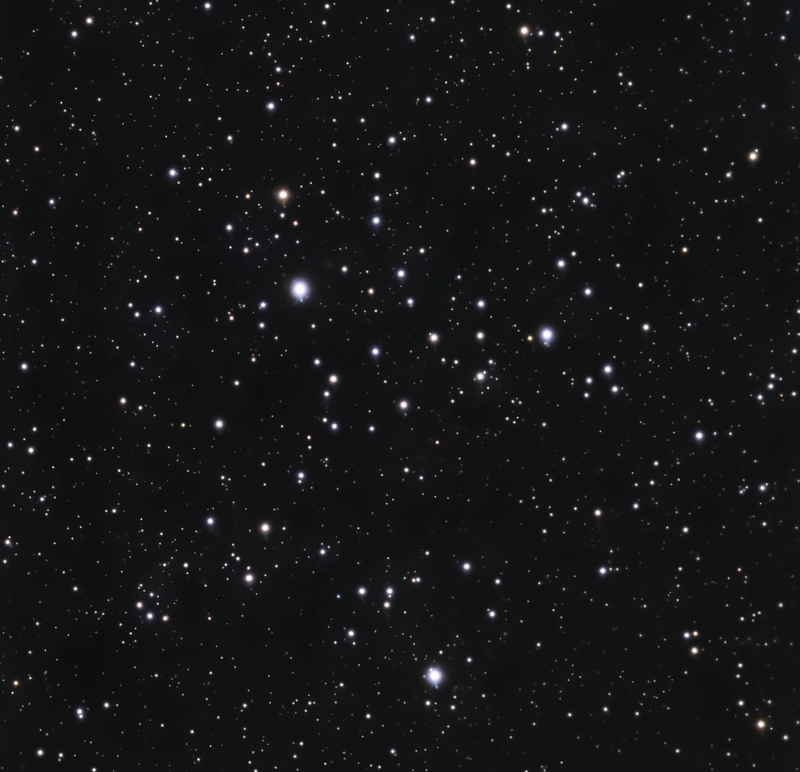
An image of open cluster Alessi 1 in Cassiopeia taken by Patrick Maloney with his SeeStar S50. Field of view is about 40’ square, and north is to the upper left. The visual impression is of a triangular, or funnel-shaped, cluster. The stars are bright, and the cluster contains a good number of stars of around 10th and 11th magnitude, which define the apparent shape. It stands out well against the fainter field stars. The brightest star in the field is HD 5083, magnitude 7.1, spectrum B8. I can't tell whether this is actually a member star or not, but my guess would be that it is not. Eventually, with more searching, the cluster takes on an elongated, much wider field than originally seen around the funnel-shaped central section.
The image was taken with a SeeStar S50. The field of view is about 40’ square, and north is to the upper left.
I find it fascinating that such an apparently obvious open cluster had to wait until 1998 before anyone spotted it, and that it then took data from the massive Gaia catalogue to confirm its reality. What else have we missed?
Object RA Dec Type Magnitude Alessi 1 (LeDrew 1) 00h 53m 27s +49° 34’ Open cluster Reference:
- Searching for Unknown Open Clusters in the Tycho-2 Catalogue, Bruno S. Alessi, André Moitinho and Wilton S. Dias, Astronomy & Astrophysics, 410 no. 2, pp 565 – 575, November 2003.
If you'd like to try out the Clear Skies Observing Guides (CSOG), you can download observing guide for the current Cluster of the Month without the need to register. CSOG are not associated with the Webb Deep-Sky Society but the work of Victor van Wulfen.
-
NGC 7293 in Aquarius
September 2026 - Nebula and Cluster of the Month
As autumn nights draw in, the brilliant Milky Way constellations of summer start to drift out of view, leaving what initially appears to be a disappointingly dull set of constellations. Amongst these is the dim sprawl of Aquarius, whose brightest star (β Aqr or Sadalsuud) shines at just magnitude 2.9. Not a huge attention-grabber. Yet Aquarius contains three Messier objects, the fine globular clusters M2 and M72 and the slightly embarrassing M73. There is a third globular cluster, fainter than the Messier objects, NGC 7492. There are also two very noteworthy planetary nebulae, NGC 7009 and the subject of this month’s article – NGC 7293.
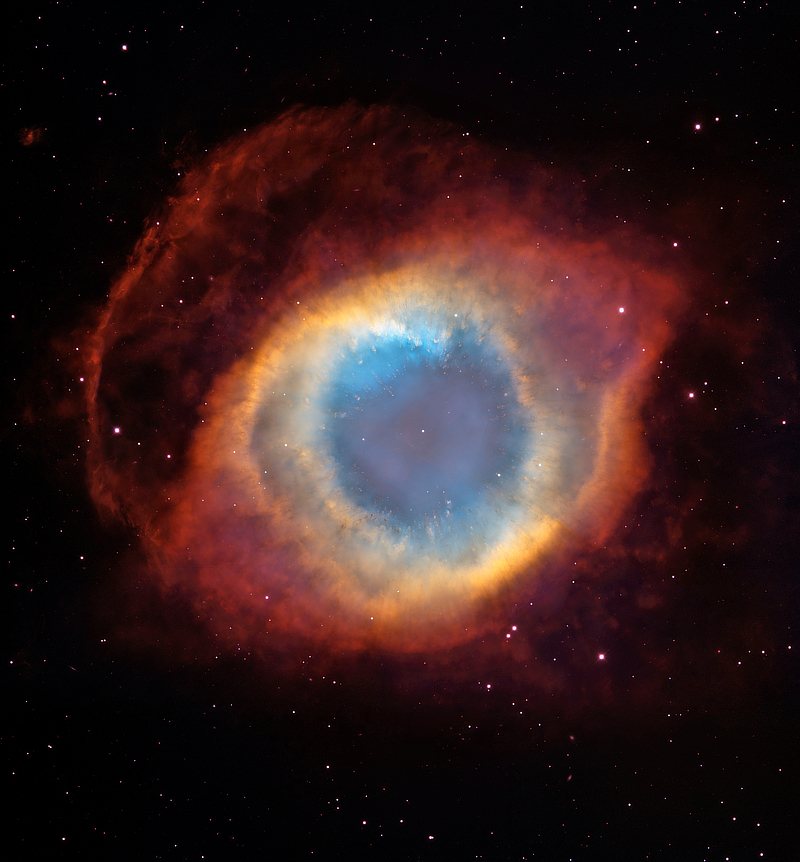
An image of the planetary nebula NGC 7293 in Aquarius, with north at the top, courtesy of NASA, ESA, C.R. O'Dell (Vanderbilt University), M. Meixner and P. McCullough (STScI). NGC 7293 was discovered by the German astronomer Karl Ludwig Harding (1765—1834). The exact date of the discovery is unknown, most probably 1823 or 1824, but it first appeared in a new list of objects compiled by Harding in 1824.
The fact that this large, bright object was overlooked by both William and John Herschel during their great sweeps gives an indication that it is perhaps not as obvious as its magnitude of 7.3 would suggest.
NGC 7293 is a large planetary nebula, measuring about 16’ x 12’, about half the diameter of the full moon. And that’s the problem. The bright magnitude of 7.3 is spread over a large area, making for a low surface brightness. It would not be an exaggeration to say that this object is actually very hard to see. However, all is not lost…
NGC 7293, predictably because of its large angular diameter on the sky, is one of the closest planetary nebulae to us. It is certainly the closest of the conspicuous ones. It lies about 650 light-years (200 pc) from us, making its true diameter about three light-years.
Deep images reveal an unusually high number of knots in the nebula. These are usually interpreted as dense condensations in the progenitor star’s circumstellar material which were subsequently exposed to the ultraviolet radiation and fast wind from the evolving star.1
There has been much research into the interaction between the expanding nebula and the surrounding interstellar medium. A faint bow-shaped feature in the outer halo has been known for some time. In 2013, measurements were made of the Hα velocities from the feature which were consistent with the overall outward velocity of the expanding material 2. The researchers’ interpretation was that the feature represented a bow shock generated as the material expands into and interacts with the surrounding interstellar medium.
Research in 2026 brought a dramatic enhancement of this previous work. Using the partially complete MOTHRA (Modular Optical Telephoto Hyperspectral Robotic Array) telescope, van Dokkum et al 3 discovered 22 compact bow shocks on the eastern outskirts of NGC 7293. Each of these is associated with an individual clump of gas blown off from the star during its AGB phase. The further from the central star they are, the smaller they are, indicating that these expelled lumps of red giant are progressively stripped and disrupted as they travel into the interstellar medium. The estimate is that they will last approximately 10,000 years after expulsion. This gives an unprecedented insight into the galactic recycling of stellar material.
Visually, NGC 7293 can be a problematic object, and this is not helped by its relatively low altitude in British skies. From central Britain, it reaches just 15.7° above the murky horizon.
I first saw it in 1998 through a 10” Newtonian reflector – admittedly from a latitude of just below 42° north. The planetary was at an altitude of 27°, so I may have been cheating a little. I was observing with a friend, and when I had found the object, I called him over. He peered into the eyepiece and grunted.
What is it? There’s nothing there.
I handed him my OIII filter and said,
Look through this.
Wow! That’s huge!
The point of this is that although initially difficult to see, it is very obvious and bright with a suitable filter, an OIII or UHC. So if you have one of those available, you stand a good chance of seeing it.
As evidence, I include an observation I made in 2015 from southern Scotland (latitude close to 55° north), when the object was 14° above the horizon.
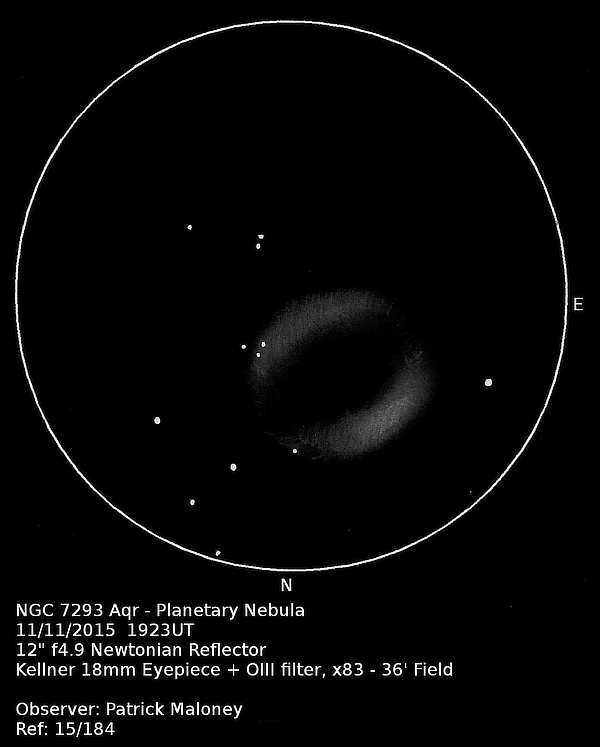
A sketch of planetary nebula NGC 7293 in Aquarius by Patrick Maloney through his 12-inch newtonian telescope at x83 magnification with an OIII filter. My journal from 1998 (using the 10” (25cm) telescope) reads
Enormous! Totally invisible without the OIII filter, unmissable with it in place. A slightly flattened ring with slight gaps at the extremities. A brighter patch is visible in the north-east quadrant.
In 2015, using my 12” (30cm) reflector, I noted
Not visible without the OIII filter in place. Huge and dim. Obvious but quite difficult to pin down the elusive details. The outer edge of the ring is almost circular, whilst the inner edge appears more elliptical. There is a distinctly brighter patch in the north-east segment of the ring, and fainter areas at the extremities.
The central star, WD2226-210 shines at magnitude 13.6. This is difficult at low elevations and of course the OIII or UHC filter will make it that much harder to see. I have never seen it.
In my opinion, NGC 7293 is one of the must-sees of the night sky, and September is the time of year to catch it at its best.
Object RA Dec Type Magnitude NGC 7293 22h 29m 38s -20° 50’ Planetary nebula 7.3 Reference:
- Matsuura, M., Speck, A.K., McHunu, B.M., Tanaka, I. & Wright, N.J. (2009). ‘A “Firework” of H₂ Knots in the Planetary Nebula NGC 7293’. The Astrophysical Journal, 700, 395–402.
- Meaburn, J., Boumis, P. & Akras, S. (2013). ‘The bow-shock and high-speed jet in the faint, 40 arcmin diameter outer halo of the evolved Helix planetary nebula (NGC 7293)’. Monthly Notices of the Royal Astronomical Society, 435, 3462–3468.
- van Dokkum, P., Abraham, R., Bowman, W.P., Chen, S., Janssens, S.R., Lokhorst, D.M., Pasha, I. & Rhea, C. (2026). ‘Numerous bow shocks in the outer Helix Nebula’. Nature, published August 2026.
-
NGC 7027 in Cygnus
August 2026 - Nebula and Cluster of the Month
August brings with it the welcome return of dark nights and also the best views of the Milky Way of the year from northern climes. Riding high, of course, is the constellation of Cygnus, the Swan. Bursting with emission and reflection nebulae, open clusters and planetary nebulae, it’s a happy hunting ground for deep-sky observers.
The New General Catalogue and Index Catalogue together list eleven planetary nebulae in Cygnus. The two brightest are both around magnitude 10, and one of these is NGC 7027. This object has held a fascination for me for many years because of its unusual morphology, which is easily detected, even in small telescopes.
The object was discovered by French astronomer Édouard Stephan (1837 – 1923 – he of the Quintet) in 1878. He described it as
planetary, stellar = 8.5m
, which is a little uninspiring. Don’t let that description put you off looking for it. It is not stellar.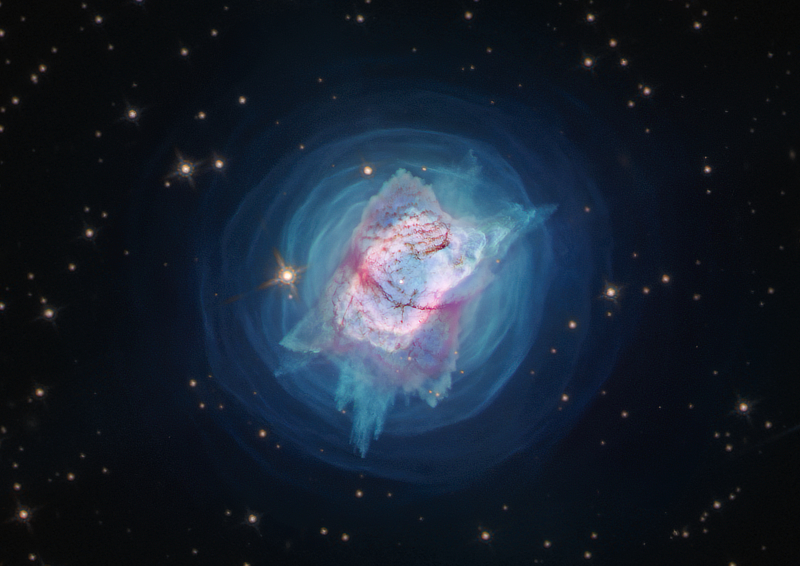
An image of the planetary nebula NGC 7027 in Cygnus courtesy of NASA, ESA, and J. Kastner (RIT) NGC 7027 has proved to be a very important object for the study of the transition of stars from the Asymptotic Giant Branch stage to the white dwarf stage, for not only is the planetary nebula relatively close (about 3000 light-years), it is also very young (only about 600 years).
Recent research using the Hubble Space Telescope (HST) and the Five-Hundred Meter Spherical Aperture Telescope (FAST), in China, has revealed multiple nested shells, intricate ionisation fronts, knots of dust and a highly structured photodissociation region surrounding the bright, ionised core. All this demonstrates that the complexity seen in the nebula results from several mass-loss events before the central star became hot enough to ionise its surroundings. In other words, this shows how planetary nebulae start to form even before they become visible.
In what seems to be an ever-more common situation, the central star has turned out to be a binary. Planetary nebulae with bipolar morphology (most of them) have binary central stars, and the gravitational interaction between the stars funnels the high-velocity bipolar outflow.
NGC 7027 lies amongst the dense Milky Way stars of Cygnus, 5½° southeast of Deneb. I have been fascinated by this object for many years, maybe because it featured on one of the Astro Card finder charts I mentioned in the article about NGC 1514 (November 2024). I made my first observation of it on 31 August 1980, through my trusty little Japanese 4½” reflector. This shows how much detail can be seen in this ‘stellar’ planetary nebula even with such a small instrument. Although at my usual power of x45 it did indeed look stellar, cranking the power up to x150 revealed remarkable detail.
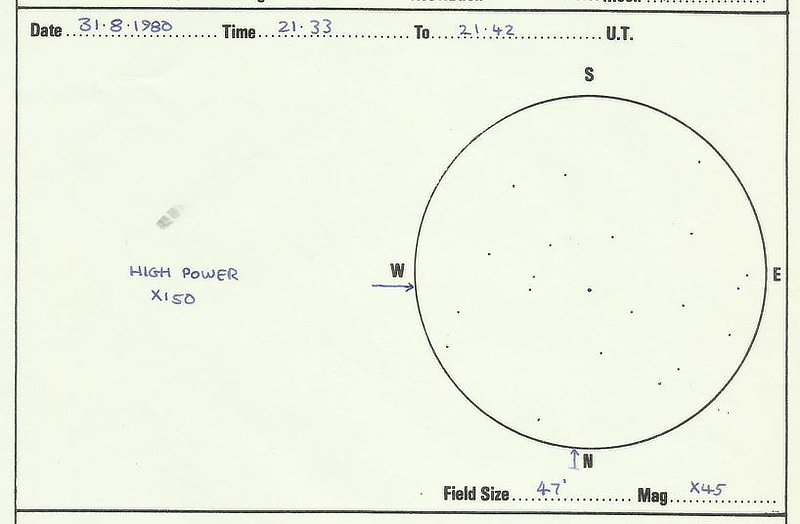
A sketch of planetary nebula NGC 7027 in Cygnus by Patrick Maloney through his 4½-inch newtonian telescope at x45 and x150 magnification. On that night, I wrote
NGC 7027 is a bright object, yet difficult to identify simply because of its small size. It can be identified only on the employment of a moderate power, which reveals, on close inspection, a rectangular object, which, in moments of superior seeing, appears to be bisected by a dark line. The nebula is elongated in PA about 45 degrees with the nebula fading off towards the SE.
I have to admit that I was dubious about the ‘dark line’ crossing the nebula for some time. I could find no photographs anywhere near good enough to show whether I had imagined it or not. I looked at it from time to time, and eventually convinced myself that it was real. I visited it again on 23 June 2014.
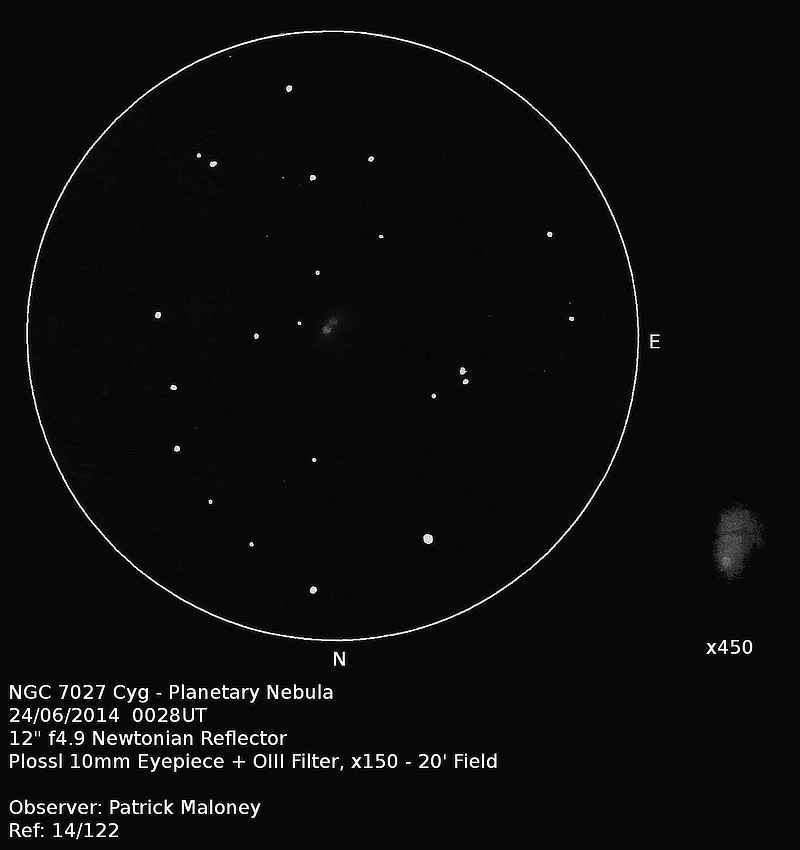
A sketch of planetary nebula NGC 7027 in Cygnus by Patrick Maloney through his 12-inch newtonian telescope at x150 magnification with an OIII filter. Once again, the dark bisecting line was clear. I wrote
Very bright and very small. It appears rectangular in shape. The northern half is brighter than the southern, with an intense bright spot in the northwest. A dark line bisects the nebula across its shorter dimension, half way along. At x450, the OIII filter reveals a fainter outer nebulosity. The filter does little for the brighter part of the nebula. Stands very high power very well, under which it appears a little more rounded. The western edge is sharper, the eastern edge tending to fade away as if ‘brushed’.
No matter what size telescope you have, NGC 7027 is a rewarding object to look at, revealing considerable detail.
Object RA Dec Type Magnitude NGC 7027 21h 07m 02s +42° 14’ Planetary nebula 10.4 -
NGC 6772 in Aquila
July 2026 - Nebula and Cluster of the Month
July brings the northern Milky Way to its midnight transit, making it more accessible and for longer than at any other time of the year. It arches high above, sweeping through Cassiopeia, Cepheus, Cygnus, Vulpecula, Aquila, Scutum, Sagittarius and Scorpius, where it is lost beneath the horizon.
These constellations are abundant in two main types of object; open clusters and planetary nebulae. Aquila alone boasts ten NGC-listed planetary nebulae. There is one IC-listed planetary and the Strasbourg-ESO catalogue adds a further sixty. Plenty for the planetary nebula hunter to aim for here, then.
This month, we’ll be looking at one of the brighter planetary nebulae in Aquila, NGC 6772. It was first seen by William Herschel on the night of 17 July 1784. He described it as
Very faint. Of equal light. Round, 1’ in diameter, in the midst of numberless stars of the milky way.
By
Of equal light
, Herschel means that there is no discernible variation of brightness across the object. It doesn’t get noticeably brighter in the middle, for example.He classed it as a planetary nebula (not by the definition of that term that we use today) and gave it the catalogue number 14 H.IV.
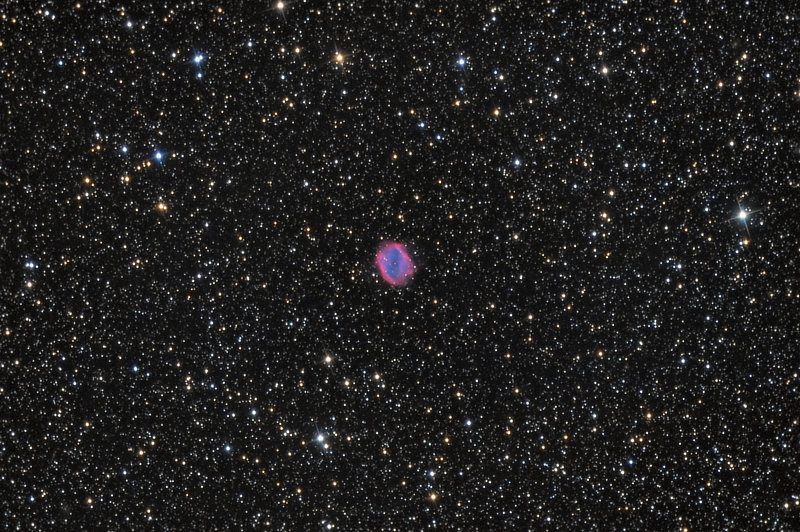
An image of the planetary nebula NGC 6772 in Aquila courtesy of Wolfgang Ries, Stefan Heutz and Michael Breite (Astro-Kooperation) NGC 6772 is not, it must be admitted, a very bright object. It shines at magnitude 12.7, and being moderately large (a little over 1’ in diameter) has a fairly low overall surface brightness, meaning it may look rather fainter than its quoted magnitude.
Whilst this may prove a difficult object for novice observers, more experienced ones will find this to be a rewarding, if subtly challenging object. If you can, search it out using a lower power eyepiece with a large exit pupil. Use of an OIII filter will also likely be necessary to identify the object. This object responds very well to OIII filtration, especially under good skies. Once found, higher powers can be employed. Experienced observers generally describe it as a diffuse, circular glow with, at best, only slight central brightening.
I managed to observe it in 2014 with my 12” Newtonian from my considerably less than perfect home site. The observation is reproduced here. My journal for the night notes that I found it large but very dim. It was barely discernible without the OIII filter in place. Even with the filter, it was still difficult. It appeared not quite round being slightly elongated North-South. There was no variation in brightness seen across the surface of the object. I managed to push the magnification up to x450 using a x3 Barlow lens with a Plossl 10mm eyepiece, without losing sight of it. If anything, it became clearer and I made my drawing at this magnification. There was no hint of a central star, but as this only glimmers dimly at magnitude 18.2, that cannot be considered surprising.
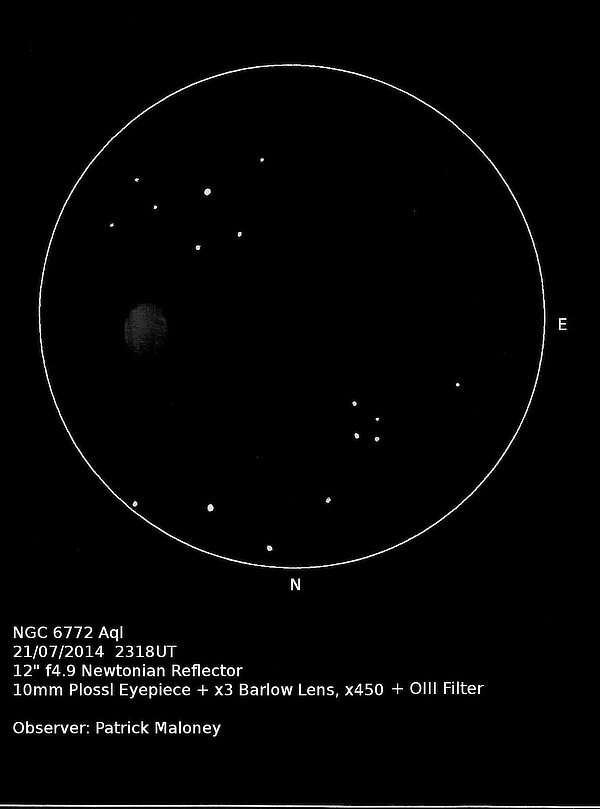
A sketch of planetary nebula NGC 6772 in Aquila by Patrick Maloney through his 12-inch newtonian telescope at x450 magnification with an OIII filter. One thing that makes NGC 6772 particularly interesting is its evolutionary state. Deep imaging reveals extensive outer structures and a distorted halo produced by interaction with the surrounding interstellar medium. Professional studies using infrared observations have found evidence that the outer envelope is being shaped and fragmented as the nebula moves through interstellar gas. These dramatic features are only visible on deep images, but knowing they are present adds an extra dimension to visual observation.
From a purely visual standpoint, NGC 6772 is best regarded as a challenging object suitable for a moderately experienced observer, or for a newer observer keen to challenge themselves and develop their observing technique. For observers working through the lesser-known planetary nebulae of Aquila, it is a satisfying target whose detection depends more on observing skill, transparency and filter technique than on telescope size alone. Under a dark British summer sky with a good OIII filter and an aperture of 10—12 inches (250—300mm) or larger, it presents itself as a delicate ghostly sphere suspended among the dense stars of the Milky Way.
Object RA Dec Type Magnitude NGC 6772 19h 14m 37s -02° 42’ Planetary nebula 12.7 -
NGC 6440 and NGC 6445 in Sagittarius
June 2026 - Nebula and Cluster of the Month
June brings with it the glories of the Summer Milky Way, but also the shortest, lightest nights of the year. It should not be assumed, however, that astronomical observation cannot take place during the period known as Astronomical Twilight. With light pollution as endemic as it is, most of us live under permanently twilit skies anyway, and yet we still observe.
The greatest glory of the Milky Way lies towards its centre, in the constellation of Sagittarius, sadly low in British skies. Given a good sky and a decent southern horizon, however, the two objects that form this month’s article should be moderately easy. These two objects are just about 20’ apart, so should both fit into the field of a good, wide-field eyepiece.
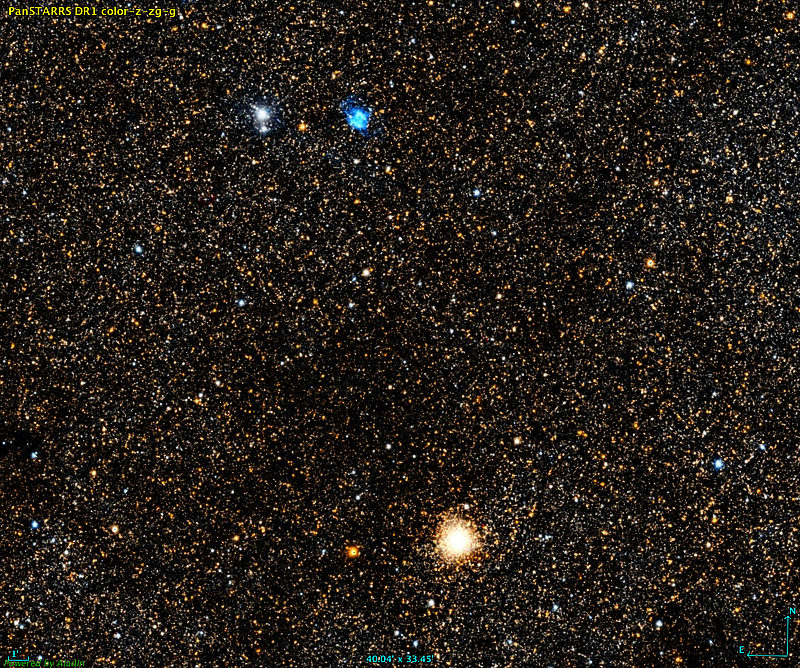
An image of globular cluster NGC 6440 (bottom) and planetary nebula NGC 6445 (top to the right of the bright star) in Sagittarius courtesy of the Pan-STARRS1 Surveys (PS1). The brighter and more southerly of the two is NGC 6440, a ninth magnitude globular cluster first spotted by William Herschel on the night of 28 May 1786. The description he gave was
Considerably bright, round, very gradually much brighter towards the middle, about 1½’ in diameter.
Herschel considered this a bright object and placed it in his first class as 150.HI.On the same night, he first saw our second object, the planetary nebula NGC 6445. He thought this a bit fainter, placing it in his second class as 586.HII. He described it as
Pretty bright, small, with an irregular figure.
The brighter of the two objects is undoubtedly the globular cluster NGC 6440. This cluster lies towards the galactic centre, about 27,000 light-years from us. It is especially rich in millisecond pulsars. Eight radio pulsars have been discovered, plus two accreting X-ray pulsars. These two objects are being ‘spun-up’ by material being accreted onto the pulsars from companion stars.1
Interestingly, one of the radio systems is a so-called ‘black widow’ pulsar – a rapidly rotating neutron star that is gradually ablating a very low-mass companion star through energetic radiation and particle winds.2 This is almost the reverse process than that occurring with the X-ray pulsars.
In the eyepiece (again, given good skies and favourable light-pollution), NGC 6440 appears as a small, almost woolly-looking ball. It is much brighter in the centre, and the edges fade away gradually. I have never achieved resolution of this globular cluster, but those blessed with better skies than me may have a good chance of doing so. The brightest stars are of thirteenth and fourteenth magnitude.
20’ slightly east of north from NGC 6440, lies our second object, the planetary nebula NGC 6445. This is a curiously-shaped nebula, the brightest portions of which form a rectangle, or box. Deeper images reveal a wealth of inner and outer structure. The nebula was formed by a solar-mass star ejecting its outer layers at the end of its red giant phase. What remains is a dense, white dwarf star surrounded by the ejected material. The structure of this ejected matter tells us a great deal about the processes that occur at this point in a star’s life. In NGC 6445, the structure is particularly complex.
A major area of recent research into NGC 6445 concerns this intricate structure. High-resolution optical and infrared observations show that the planetary nebula contains a bright inner ring embedded within extended bipolar lobes. Researchers have interpreted these features as evidence for multiple episodes of mass ejection from the dying central star, possibly influenced by binary interactions or asymmetric stellar winds. Studies of comparable nebulae using the James Webb Space Telescope have reinforced the view that many bipolar planetary nebulae are shaped by highly collimated outflows and complex dynamical processes rather than simple spherical expansion.
Visually, NGC 6445 is less prepossessing than its deep images suggest. It’s quite faint at magnitude 11.2, but an OIII filter (or Nebula filter) should suffice to bring it out from the background. Moderately high power and some careful use of averted vision can, on occasion, reveal the rectangle, though this is likely to appear as an elongated ring.
Seen together in a wide-field view, these two objects provide a fascinating contrast, both in their visual appearance and in the wild differences in their natures.
Object RA Dec Type Magnitude NGC 6440 17h 48m 53s -20° 22’ Globular cluster 9.1 NGC 6445 17h 49m 15s -20° 00’ Planetary nebula 11.2 Reference:
- Discovery of a 205.89 Hz Accreting Millisecond X-ray Pulsar in the Globular Cluster NGC 6440, Altamirano, D. et al., The Astrophysical Journal Letters, Volume 712, Issue 1, pp. L58-L62 (2010).
- Discoveries and timing of pulsars in NGC 6440, L Vleeschower et al., Monthly Notices of the Royal Astronomical Society, Volume 513, Issue 1, June 2022, Pages 1386–1399
-
NGC 5897 in Libra
May 2026 - Nebula and Cluster of the Month
This month’s object is a globular cluster in Libra, famous for its elusiveness. Unsurprisingly, it was another discovery of William Herschel’s. Herschel obviously lived at a time when light pollution still lay in the future, and we can only dream about the skies he enjoyed, even in urban settings. He first described this object on the night of 25 April 1784 as
A very compressed cluster of stars, 8 or 9’, extremely rich, irregularly round or little elongated.
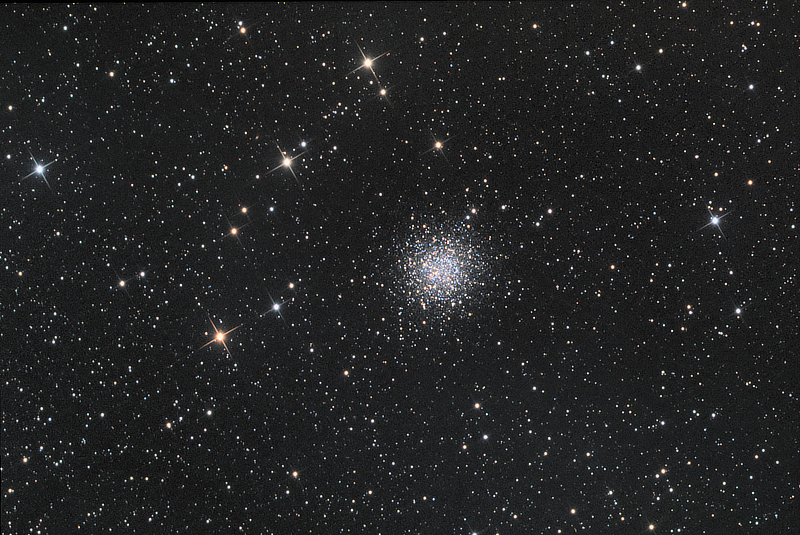
An image of globular cluster NGC 5897 in Libra courtesy of Gregg L. Ruppel. He then observed it again on the night of 10 March 1785, writing
A beautiful large cluster of the most minute and most compressed stars of different sizes, 6 or 7’ in diameter. Irregularly round, faint. Red colour.
Initially, he did not recognise that these observations were of the same object and so it entered his catalogue (VI = Very compressed and rich clusters of stars) as both 8H.VI and 19H.VI. It eventually passed into the New General Catalogue with the number 5897, with the description
Globular cluster. Pretty faint, large, very irregularly round, very gradually brighter towards the middle, very easily resolved.
NGC 5897 lies about 40,000 light-years from us. The angular diameter, as measured with modern methods, is 10—12 arcminutes, corresponding to an actual diameter of 150—170 light-years. It is very loose in concentration, being classified as a type XI cluster on the Shapley-Sawyer scale of globular cluster concentrations. The very loosest globulars are of type XII. This has consequences both for the physics of the cluster and for its visibility.
A defining characteristic of NGC 5897 is its very low metallicity. The stars within the globular have iron abundances of less than 1% that of the sun. This places it amongst the metal-poor halo globulars and indicates a very great age. In fact, NGC 5897 probably formed before the Milky Way had developed its core, bar and spiral arms.1
Despite this low metallicity, the stars in the cluster clearly represent several different populations, confirming that even such diffuse clusters undergo multiple star-forming periods and self-enrichment.
A notable feature is the presence of blue straggler stars – stars that appear younger and more massive than the cluster’s main-sequence turn-off population. Their existence is generally interpreted as the result of stellar mergers or mass transfer in binary systems, processes facilitated by dynamical interactions even in relatively low-density clusters.
Age estimates place NGC 5897 at roughly 10—12 Gyr, possibly older than some benchmark clusters such as M3 by about 2 Gyr, reinforcing its status as an early Galactic fossil.
The low density and poor concentration of the globular cluster contribute significantly to its reputation as a difficult object for visual observers. In addition, it is low-lying from our shores, never reaching much over 15° above the horizon from mid-Britain. Although the magnitude is usually quoted as 8.4, this does not compensate for the poor concentration. I must admit now that I have never had a satisfactory view of it from my suburban location. I have suspected it a couple of times, but never strongly enough to report a positive observation.
The key in searching for globular clusters like NGC 5897 is not to look for an obvious diffuse ‘ball’, but instead to look for a small scatter of very faint stars. For a discussion of this, see my article on NGC 5466 (April 2025). The brightest stars in NGC 5897 are of the order of magnitude 13, so not too much of a stretch for a moderate telescope.
Much of what I say there is also true for NGC 5897, in many ways a visual twin to NGC 5466. The problem is exacerbated for NGC 5897 by its low altitude. You should not expect to see a globular cluster like the lovely image at the top of this article. You’d be forgiven for thinking that it should present little difficulty from that. The underexposed image below gives a much better idea of what to expect visually. This shows stars to about magnitude 16 or 17.
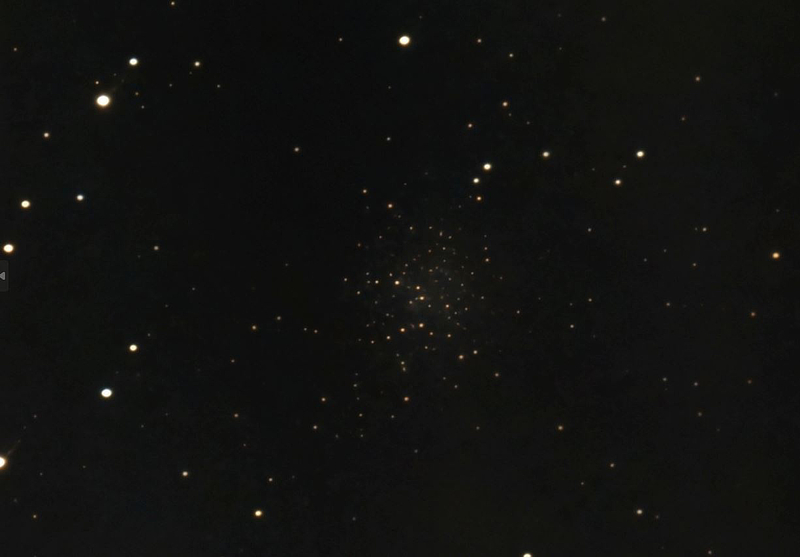
An image of globular cluster NGC 5897 in Libra by Patrick Maloney. Object RA Dec Type Magnitude NGC 5897 15h 17m 25s -21° 08’ Globular cluster 8.4 Reference:
- Chiti, A. et al. (2025), DELVE-ing into the Milky Way's Globular Clusters, arXiv preprint.
-
NGC 4361 in Corvus
April 2026 - Nebula and Cluster of the Month
The subject of this month’s article first came to my personal attention in 1977, whilst I was eagerly looking through my newly-obtained copy of the Skalnate Pleso Atlas Coeli, first compiled by the Czech astronomer Antonín Bečvář in 1951 and republished in 1962. Within its wonderfully oversized pages, I spotted a green circle, indicating a planetary nebula, framed by the four stars of the kite asterism of Corvus. It was labelled ‘4361’, the ‘NGC’ being implied.
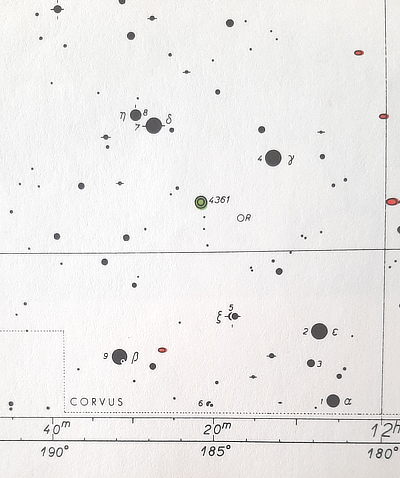
A photograph of the fateful page from the Skalnate Pleso Atlas Coeli provided by the author. NGC 4361 was first seen by William Herschel on the night of 7 February 1785. He described it then as
Very bright, pretty large, irregularly round, brighter in the middle, like 2 nuclei
. Interestingly, Herschel did not describe it as a ‘planetary nebula’ and place it in his class IV, but simply as a ‘bright nebula’. It entered his catalogue with the designation 65H.I.NGC 4361 has proved significant in the study of planetary nebulae and their central stars because of its unusually high ionisation, low metallicity and an optically thin structure. These factors make it a valuable case-study in the understanding of stellar evolution and nebular physics.
The central stars of planetary nebulae are low- to intermediate- mass stars which have passed through the asymptotic giant branch of the Hertzsprung-Russell diagram. Late in this stage, the stars expel their outer envelopes to leave the extremely hot central remnant that then illuminates and ionises the material that has been expelled. The temperature of the central star in NGC 4361 is in excess of 100,000K. The high-energy photons emitted from the star are capable of ionising helium twice, producing HII emission lines in the object’s spectrum. The relative strength of the HII lines in the spectrum indicates how highly ionised the nebular material around the star is. NGC 4361 is one of the most highly ionised known planetary nebulae.1
The spectrum of the central star also shows low metallicity (basically meaning a dearth of heavier elements). This indicates that the progenitor would have been an old, population II star. It therefore provides a window into the late life of an older generation of Milky Way stars.
During the investigation into the nebula by Walsh et al (see reference 1), a small region of the planetary nebula was discovered to be emitting at a wavelength of 670.3nm (6703Å). Closer investigation revealed further lines which do not match planetary nebula lines. It was concluded that there is an emission galaxy behind the planetary nebula and shining through it. It has been given the snappy designation NGC 4361-BgGal1224290-184707. (If you really want to look, it’s 24.3” west of the central star. If you can see it, do let me know!)
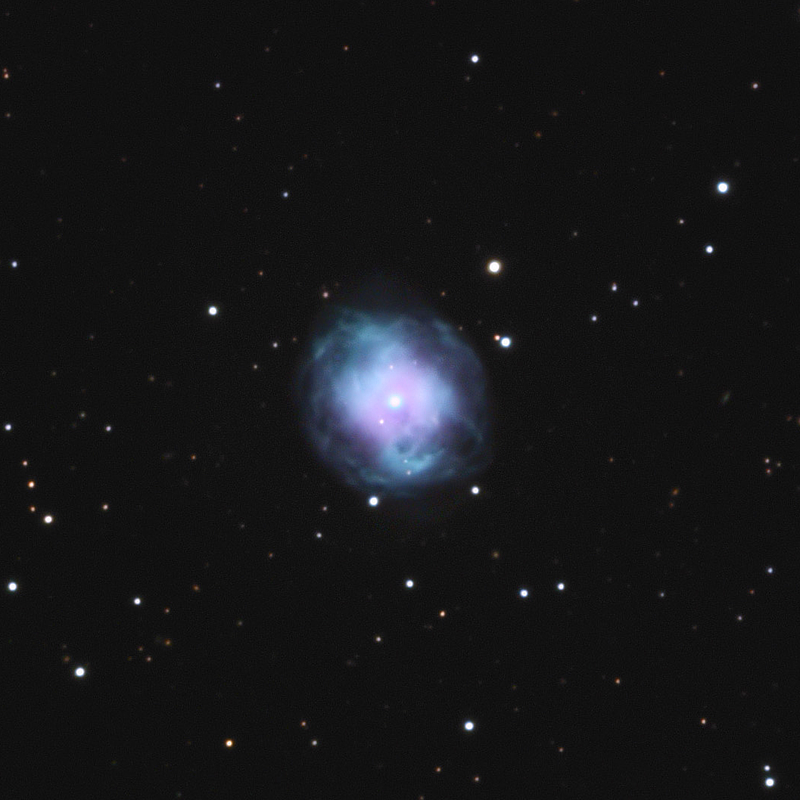
An image of planetary nebula NGC 4361 in Corvus courtesy of Adam Block/Mount Lemmon SkyCenter/University of Arizona. NGC 4361 shines with a visual magnitude of 10.9. It is just shy of 2’ wide along its longest axis. This should be an easy object, and under good conditions it is, but as many of us live with constant light pollution, especially at low altitude, it can be a challenging object to observe. From mid-Britain, the highest it gets is 17.5°.
Even though my attention was first drawn to it in 1977, I didn’t get to see it until 2001, when I was lucky enough to be attending the Winter Star Party in the Florida Keys. There I used a 16” (400mm) Newtonian reflector for my first view of this object. I noted a very bright ring, clearly detached from the 13.2-magnitude central star. I could see an elongation in PA about 230°. This ring effect is caused by slightly darker (presumably less abundant) nebulosity in the immediate vicinity of the central star. It’s subtle, and can be quite hard to detect in suboptimal conditions.
My next view of NGC 4361 was from light-polluted, further-north home in April 2016. The observation was in stark contrast to the 2001 sighting.
Very faint, blurred and distorted. The atmosphere was very turbulent at this altitude (17.5°). Quite large but almost no detail seen - perhaps a slight elongation. The middle is brighter and there was the occasional glimpse of a central star. A very disappointing view.
Undeterred, I tried again from a dark sky site in May of 2016. I was rewarded with a better view (pictured here) and recorded in my log
Pretty bright for its altitude (16.5° - I was 1° further north than my home site). Circular with a bright centre. A central star pops in and out of view. There was possibly the occasional glimpse of a ring structure.
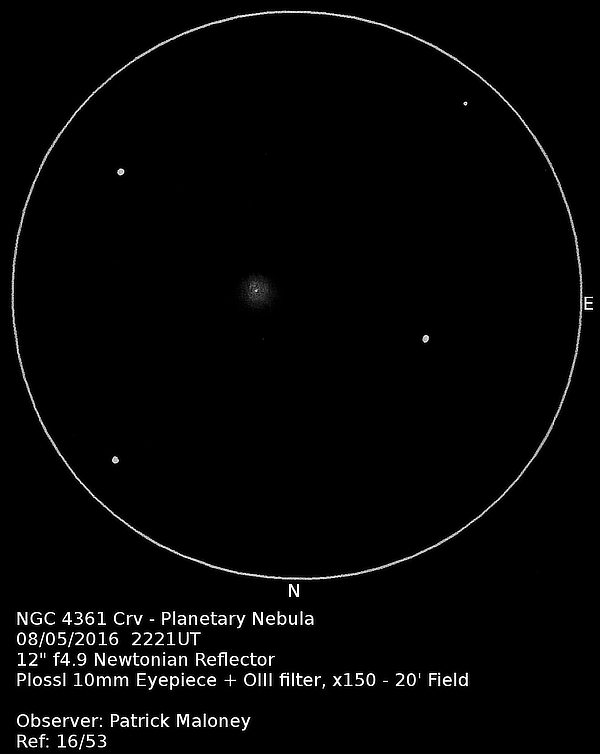
A sketch of planetary nebula NGC 4361 in Corvus by Patrick Maloney through his 12-inch newtonian telescope at x150 magnification with an O-III filter. This can be a challenging object, but as so often with difficult targets, it pays back the effort put into seeing it.
Object RA Dec Type Magnitude NGC 4361 12h 24m 31s -18° 47’ Planetary nebula 10.9 Reference:
- Dissecting the Planetary Nebula NGC 4361 with MUSE, Walsh et al, Astronomy & Astrophysics, Volume 690, A264 (2024).
-
Collinder 95 and NGC 2245 in Monoceros
January 2026 - Nebula and Cluster of the Month
I’d like to start by wishing you all a very happy and prosperous new year.
This month we’re going to look at an object which at first looks straightforward but which presents a conundrum if we dig deeper.
The object is the open cluster Collinder 95 in Monoceros. It’s not a bright, splashy cluster but nevertheless deserves some attention. It was first listed by the Swedish astronomer Per Arne Collinder (1890—1975) in his catalogue of open clusters, published in 1931. Collinder’s catalogue appears as an appendix to his paper On Structural Properties of Open Galactic Clusters and their Spatial Distribution. The purpose of the study was to provide a systematic collection of objects with measured (or at least estimated) quantities – position, apparent diameter, number of stars, total magnitude, concentration, etc. – as the basis for a discussion on how clusters differ in structure, richness and spatial placement within the Galaxy.
Collinder listed 471 objects – not all of which were open clusters. There are a few globular clusters and asterisms, but the vast majority are open clusters. Many of the objects were already known and had previous catalogue entries. About 60 were new identifications. Cr 95 is one of these.
With the proliferation of catalogues these days, Cr 95 now has other designations: Lund 225, OCl 491 and the soulless C0627+099. It also appears to be no. 14 in the obscure Alessi catalogue of ‘unknown open clusters in the Tycho-2 catalogue.’

An image of open cluster Cr 95 surrounded by the nebulosity of NGC 2245 in Monoceros by Patrick Maloney with his ZWO Seestar S50. Cr 95 has in the past been rather poorly studied, often being overlooked because of its relative sparseness. The European Gaia satellite, launched in 2013 and operational until 2025, provided unprecedentedly accurate astrometry for billions of Milky Way stars. This dataset has allowed for far more detailed investigation into hundreds of open clusters. Importantly, Gaia data allows for a much more certain membership selection for stars in sparse or widely scattered clusters. In the case of Cr 95, its existence as a true cluster has been confirmed, and that it lies relatively nearby (a few hundred light-years). It is a young cluster, certainly, but here we hit a snag. Two standard ways for determining the age of an open cluster are isochronal aging and kinematic aging. The isochronal age of a cluster is determined, basically, by the spectral analysis of the member stars. Different mass stars will evolve at different rates, and numerical analysis is performed to determine the cluster’s age from the spectra of its member stars. Kinematic ageing is based on the motion of the stars, which are assumed to have had a single place of birth.
The problem with Cr 95 is that these derived values do not match. Specifically, the kinematic studies return an older age than the isochronal studies. The conclusion drawn from this inconsistency is that the member stars of Cr 95 did not have a single birthplace.
Cr 95, then, may be a representative of clusters whose origin is distributed or partly unbound, as opposed to the more common ‘monolithic’ open clusters. The member stars, then, are cousins rather than siblings.
To find Cr 95, you’ll need to move 8.5° east-north-east of Betelgeuse (α Orionis). Alternatively, start at the much better-known open cluster NGC 2264 and move 2.5° due west.
The cluster fills an area about the same size as the full moon. The brightest stars are of eighth- and ninth-magnitude, but do stand out against the background. The cluster is better seen on low, finding powers.
There is much nebulosity mingled with the stars of the cluster. This carries various designations, individual sections being labelled vdB 76, vdB 77, vdB 78 and vdB 79. Overall, it is classed as IC 447.
The brightest of this nebulosity is in the southern half of the cluster, gathered around a triangle of eighth and ninth magnitude stars. Curling north from this, through the rest of the cluster and beyond, is a great semicircular dark nebula, LDN 1599.
The image that I took with my SeeStar 50 shows this clearly. Not visible in the image but just off the top left of it, the dark nebula curls round to a bright patch of nebulosity around a 10.4-magnitude star. The star is 3UC201-059373 and the nebula is NGC 2245.
NGC 2245 is clearly visible in a modest telescope. My observation of it through my 12” Newtonian reflector is shown. On that night, I described it as
A small, bright nebula around a tenth-magnitude star, stretching away from it like a short cometary tail.

A sketch of reflection nebula NGC 2245 in Monoceros by Patrick Maloney through his 12-inch newtonian telescope at x150 magnification. Whilst the nebulosity around Cr 95 is clear in long-exposure images, it is far from clear visually. I suspect that the clearest sky and some hefty aperture would be needed to see it. I certainly never have.
If you use the Guide 9 planetarium program, note that Cr 95 is immediately to the east of where the cluster is marked. The position is correct in MegaStar.
Object RA Dec Type Magnitude Cr 95 06h 31m 09s +09° 51’ Open cluster 8-ish NGC 2245 06h 32m 42s +10° 09’ Bright nebula -


