-
NGC 777 in Triangulum
November 2023 - Galaxy of the Month
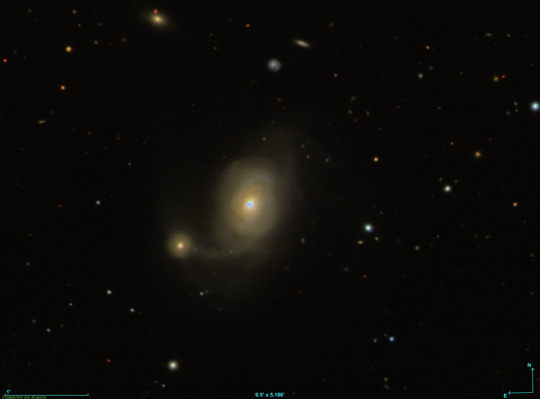
This interactive image of the NGC 777 and was provided by the Sloan Digital Sky Survey (SDSS) using Aladin Sky Atlas. We also have a finder chart should help you locate these galaxies, as will this link for NGC 777 on the Stellarium Web planetarium. It is becoming harder to find interesting galaxies that are not too faint to feature in the GOM blog. This month I have chosen the pair of galaxies NGC 777 and NGC 778 in Triangulum.
NGC 777 was discovered by William Herschel in 1784 but the much fainter NGC 778 had to wait until 1866 when it was discovered by Safford using an 18” refractor at Dearborn observatory in the US, although it was independently rediscovered by Stephan in 1875 using the 30” silver of glass reflector at Marseille. Safford did not publish his observations until 1887, after the NGC was completed.
NGC 777 is an elliptical galaxy, classified as E1, with a weak active nucleus of the LINER or Seyfert 2 class. The nucleus shows as a bright X-Ray source. It may also be an outlying member of the cluster Abell 262. It lies at a distance of perhaps 187 million light-years. NGC 777 and 778 may form a non-interacting pair. NGC 777 is also included as part of a group of galaxies catalogued as LGG 42 which has 13 galaxies involved including NGC 750, NGC 751, NGC 761, NGC 777, NGC 783, NGC 785 and NGC 789, although interestingly not NGC 778.
NGC 778 has been classified as an S0, i.e. a lenticular galaxy and according to NED lies much further away than NGC 777 so they may just be an optical pair. It has also been classified as SAB(s)a, which fits with observations with the GALEX satellite in the UV suggest that there may be a ring of star formation in NGC 778 which would be at odds with its lenticular classification. The SDSS image also shows the suggestion of a bar and spiral arms. There are suggestions that NGC 778 may also be a starburst or Seyfert galaxy. NGC 777 just shows a bright core in the UV.
The The Night Sky Observer's Guide (NSOG) Vol 1 suggests that the pair should be visible in 12-14in (30-35cm) scopes as a faint pair. NGC 777 should be relatively easy and NGC 778 shows as a bright nucleus with a fainter halo. I suspect that as usual from the more polluted skies of the UK that it may well require 40cm to show the same views. Mark Stuarts observation of NGC 777 with a 40cm show it to be faint but there is no mention of him seeing NGC 778.
Owen Brazell - Galaxy Section Director
-
NGC 7771 Trio in Pegasus
September 2022 - Galaxy of the Month

This interactive image of the NGC 7771 was provided by the Sloan Digital Sky Survey using Aladin Sky Atlas. We also have a finder chart should help you locate these galaxies, as will this link for NGC 7771 on the Stellarium Web planetarium. For the September GOM I have chosen the tight galaxy trio in Pegasus around NGC 7771.
There are three NGC galaxies in the trio, NGC 7769, NGC 7770 and NGC 7771. All three of the galaxies were discovered on the same night by William Herschel in September 1784. For EAA observers there are two much fainter galaxies in the same field. The three galaxies appear to form a physical group along with LEDA 214993, also known as NGC 7771a. They are also classified as Holmberg 820. They also make it into both the WBL (726) and LGG (483) galaxy group catalogues.
Both NGC 7770 and NGC 7771 appear to be slightly distorted from a gravitational interaction. All three appear to be spiral galaxies with all of them appearing to have a lot of star formation going on from the brightness in the UV images from GALEX. NGC 7771 is also classified as a luminous infrared galaxy (LIRG) starburst which also suggests that a lot of star formation going on is hidden by dust. It will be interesting to see if Webb images it as Hubble used its near infra-red camera to get an image of the centre of NGC 7771.
The distance to the group is thought to be about 60Mpc. The group appears to have been interacting for some time as there are numerous star streams in the group. Over cosmic time all three galaxies are likely to merge. It is not clear if NGC 7771a is part of the triplet as there is very little hard information on it. Unfortunately deep images of the group are complicated by the presence of dust (IFN) in our own galaxy in front of the group, although there is a fine amateur image of the group by Capella observatory showing some of the interaction details. Despite the group not make the Arp atlas it is added as VV 2003 in the revised Vorontsov-Velyaminov catalogue, although this may only apply to NGC 7770.
The Type II supernova SN2022mxv was discovered in NGC 7769 but only reached maybe 15th magnitude. NGC 7769 is also suspected to be a LINER, a weak form of AGN.
The Night Sky Observer's Guide (NSOG) Vol. 1 suggests that to see the whole group then you will require a telescope in the 40-45cm class and even then NGC 7770 will only appear as a faint smudge. The brightest galaxy in the Trio is actually NGC 7769 so that should be the easiest to find. As the group is so tight it will be worth using the highest power you can get away with to separate them and to increase the contrast to see NGC 7770.
The group also makes it into the Cambridge Photographic Atlas of Galaxies. They are also included in Alvin Huey’s guide to Galaxy Trios as well as Miles Paul’s Atlas of Galaxy Trios, downloadable from the Webb Society website. The group has been included in the Herschel 300 list, an extension to the better known H400 and H400 II list.
Owen Brazell - Galaxy Section Director
-
NGC 7778 in Pisces
October 2019 - Galaxy of the Month

This interactive image of the NGC 7782 group was provided by the Sloan Digital Sky Survey using Aladin Sky Atlas. We also have a finder chart should help you locate these galaxies. My thanks to Mark Stuart for recommending this rather nice group of galaxies in Pisces. Three of these galaxies, NGC 7778, NGC 7779 and NGC 7782 were discovered by William Herschel in November 1784 and the fourth galaxy NGC 7781 was discovered by his son, John, in 1830 whilst reobserving his father’s objects. Also in this field, but very much fainter is the edge on galaxy, RFGC 4209.
All of the NGC galaxies are included as a group WBL 727 which contains just the four NGC galaxies. The group is often called the NGC 7782 group after its brightest member. It also seems to be classified as cluster Zwicky 2350.6+0758.
NGC 7778 and NGC 7779 are regarded as a physical pair, despite this they do not seem to show any signs of gravitational interaction. NGC 7778 is an elliptical whereas NGC 7779 appears to be a face on spiral with a very bright core, although it has also been classified as a lenticular galaxy. Both of these galaxies were digitised as stars in the GSC catalogue due to their bright cores.
The group lies at a distance of perhaps 70 Mpc. The group is classified as a triple system in Alvin Huey’s guide to Galaxy Trios. Interestingly he does not include NGC 7782 as part of the triple but adds NGC 7781.
Whilst NGC 7778 and NGC 7779 should be visible in relatively small instruments NGC 7781 will be far more of challenge with a listed blue magnitude of 15. It may be much brighter however in the visual, perhaps at 14th magnitude, nevertheless I would expect that from UK skies at least 40-cm will be needed to see it.
The Night Sky Observer's Guide (NSOG) also includes a fifth galaxy, NGC 7780, in this group. Although probably not physically associated with the NGC 7782 group, NGC 7780 was discovered by Stephan in 1881 and independently by Swift in 1886. Both NGC 7780 and NCG 7781 are likely to be challenges for 45-cm telescopes according to the NSOG. NGC 7780 was host to sn 2001da. If these prove too easy then near NGC 7780 is MCG+1-60-44 for large telescopes.
All five NGC galaxies should fit in the field of view of a medium power (240x) modern hyperwide (100 degree) eyepiece.
If these galaxies are all too easy then try for RFGC 4209. I am not sure if RFGC 4209 will be visible in normal amateur class instruments however, perhaps some of the giant Dobsonians that seem to be around could give it a go. Here RFGC stands for the Revised Flat Galaxy Catalogue by Karachentsev et al. There are 4236 galaxies in this catalogue with axial ratios (a/b)B ≥ 7. Within this group RFGC 4209 would be classified as an Ultra thin. It is also known as LEDA 091829 but has no listed magnitude. It is not part of the group being much more distant. There is some interesting information and an image of this group at ManTrapSkies.
Owen Brazell - Galaxy Section Director
-
Deep-Sky Objects and Observations
