These are our observations in Cepheus
-
NGC 7538 in Cepheus
It's been a while since I shared an astrophotography image with you. Indeed, I think my last one was in April.
During April, my suspicions that something was seriously amiss with my EQ8 mount were confirmed and resulted in a complete dismantle and rebuild with parts repaired and other parts replaced as upgrades. The work took until late July when I was able to start re-tuning the mount and working with some new software tools.
This image, therefore, represents my return to imaging with the repaired equipment.
I selected NGC 7538, Sh2-158 as my target. This is quite a small but very attractive star-forming region in Cepheus is around 9,100 light-years from us. It has been reported to contain the largest protostar system observed to date, around 300 times the size of our solar system. It is not frequently imaged as most prefer to concentrate on its brighter and showier close neighbour, the Bubble Nebula.

This image of NGC 7538 in Cepheus was provided by David Davies and taken from Cambridge in the UK. To see more of David's work please visit his Flickr Photostream. Click on the image for the larger version. Image Details
The image data was gathered during September 2021 and comprises nine hours of LRGB data, with two hours each of RGB in 10-minute subs and three hours of luminance data, also in 10-minute subs all binned 1x1.
- Telescope: 200mm Ritchey-Chretien, Lodestar off axis guider.
- Camera: QSI 683 with Astrodon filters.
- Mount: Skywatcher EQ8.
David Davies - (7 October 2021).
-
NGC 188 in Cepheus
I have upgraded the mount in my observatory from an EQ6 to an EQ8 and have taken the opportunity for a restructuring of the cabling and power supplies.
Looking for an interesting challenge as a first image, I selected NGC 188. At just 4 degrees from Polaris, it represents a challenge for observers with an equatorial mount due to the awkward geometry and is in a part of the sky that is not often observed.
First discovered by John Herschel in 1831, NGC 188 is an open cluster of old yellow stars sitting about 1,600 light years above the galactic plane and 5,000 light years from us. It is moderately faint, with a combined magnitude of 8.1 and containing around 200 stars of 10th to 18th magnitude with the 10 brightest stars being yellow giants.

This image of NGC 188 was provided by David Davies and taken from Cambridge in the UK. To see more of David's work please visit his Flickr Photostream. Click on the image for the larger version. Image Details
- Telescope: APM 107 Apo refractor
- Camera: QSI 583 with an SX Lodestar as off-axis guider
- Mount: Skywatcher EQ8
- Software: Pixinsight and Photoshop
David Davies - (22 November 2018).
-
STF 2840 in Cepheus
September 11th saw a clear spell following the band of rain. The air was crystal clear (NELM 5.5) after the rain so I needed no encouragement to set up the gear.
STF 2840 was last observed in 2016 and I recorded that I thought component A might have a hint of blue about it. Using x133, this time I could not decide if it had a blue hue or not, so I stuck with white.
Interestingly so when I defocused the pair I noticed the companion was definitely darker in colour and had a hint of yellow to it. At x220 the companion was definitely darker but no hint of blue for the main star.
Using AV at x220, I was just able to detect the mag 13 component. At x133 there is a nice collection of two brighter stars with several faint ones in attendance – delightful.
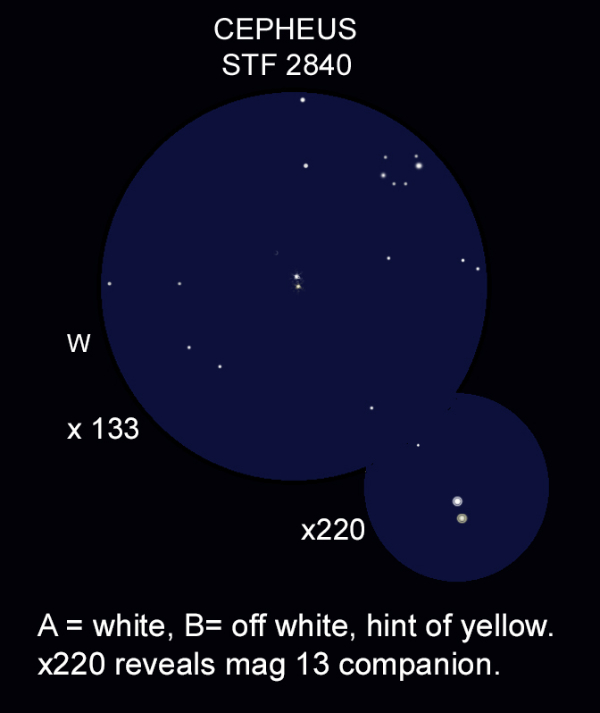
Double star STF 2840 in Cepheus sketched by Mike Wood through his OMC 200. Mike Wood - 13 September 2017
-
Partial Success in Cepheus
September 4th did not look promising as broken cloud made observing difficult. However a clear gap which stayed for a while gave me a chance to enjoy STT 461 for 30 minutes and it was well worth it.
Using a Meade 127 at x158 gave a close in view but as I reduced the magnification the beauty of the double (multiple) was revealed as it became framed by the surrounding stars.
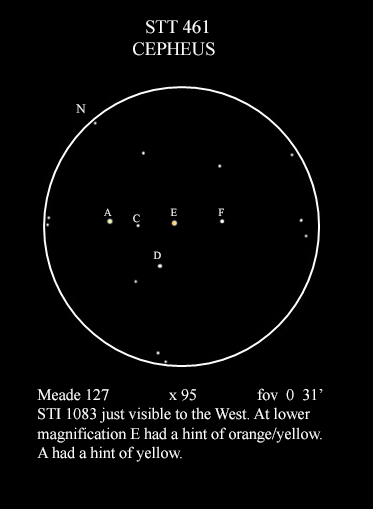
The best view was at x32 (fov 2° 31’) with hints of colour being visible in component E (yellow/orange) and A (hint of yellow). I could not locate component B, mag 11.4. I was however able to locate what I think is the nearby faint double of STI 1083 (AV needed). I shall plan to revisit this night sky gem with a bigger telescope to locate “B” and confirm STI 1083.
Mike Wood - 5 September 2016
The Revisit
September 8th saw a clear sky with good transparency and reasonable seeing. Having viewed a few clusters in Cassiopeia I pointed the Meade 127 at STT 461. It looked absolutely lovely in the clear, dust free air. Would I be able to spot component B at mag 11?
I popped in the 20 mm Vixen SLV and I almost let out a whoop of delight. There it was nestling close to star A. I looked at the other stars and then came back to A and sure enough there was its companion lurking where it should be.
Pleased I had made the effort to view this double (multiple) again.
Mike Wood - 10 September 2016
-
Observation of STF2816 from Haw Wood
Double of the month (STF 2816), located in the Cepheus cluster Trumpler 37. It is a wonderful sight to see the three components sparkling away surrounded by a rich star field. I just could not resist a sketch.

Mike Wood - 14 October 2015


