-
NGC 2805 in Ursa Major
January 2021 - Galaxy of the Month
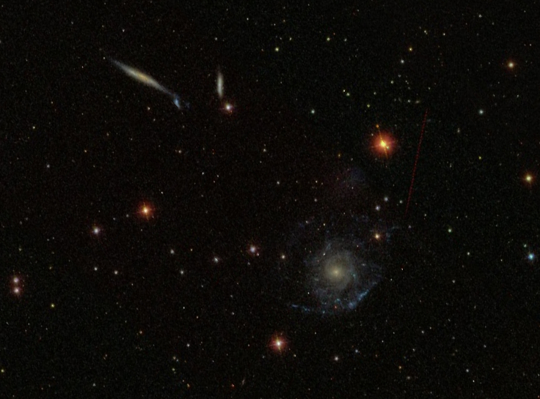
This interactive image of the NGC 2805 and was provided by the Sloan Digital Sky Survey using Aladin Sky Atlas. We also have a finder chart should help you locate these galaxies, as will this link for NGC 2805 on the Stellarium Web planetarium. The small group of galaxies around NGC 2805 has an interesting discovery history. Three of them, NGC 2805, NGC 2814 and NGC 2820 were discovered by William Herschel in 1791. The last galaxy in the group is listed as either NGC 2820A or IC 2458. However, it appears that Bigourdan, who discovered IC 2458 in 1899, really meant to apply that designation to a knot in NGC 2820 so the galaxy is not the IC object. This small galaxy is also known as Markarian 108. John Herschel also managed to add to the confusion in the area as he recorded another nebula that became NGC 2816. NGC 2816 is however just another observation of NGC 2820 so that number should be retired.
The group also became known as Holmberg 124 after Erik Holmberg’s catalogue of double and multiple galaxies in 1937 that he found from early photographic plates, an effort that was corrupted by poor images and led to a number of false identifications. The group is also catalogued as LGG 173 which adds NGC 2880 to the group to make a 5 galaxy system, which is slightly odd as NGC 2880 is almost 2 degrees away from the others.
The group is classified as a poor galaxy group and consists of mostly late type spirals. The distance to the core of the group is around 90 million light-years or so. GALEX images in the UV show a lot of active star formation going on which suggest that the group has interacted in the recent past to stir up the star formation. The group does not show up so well in the IR WISE images. NGC 2814 in particular shows a number of knots, a bit like M82, and almost looks like two galaxies in collision. NGC 2820A also appears very disturbed.

WFC image of NGC 2805 by the Hubble Space Telescope. NGC 2805 is a face on spiral with well-defined arms in the central part but somewhat asymmetric arms further out. On the Sloan Digital Sky Survey (SDSS) image there is a diffuse patch that I initially thought was another dwarf galaxy in the system but is more likely to be an artifact from the bright star in the field as it does not appear on other survey images. There is a nice image at ManTrapSkies.com. NGC 2805 was also host to the recent supernova 2019hsw. Interestingly although the galaxies around NGC 2820 show signs of interacting with each other from their radio emission and there is a tidal bridge between all of them, there is no tie up with NGC 2805. It also appears that there may be a tidal dwarf galaxy created in the streams from NGC 2820 to the NE of it.
The group is fairly compact and will fit in the field of a medium power (say 260x) hyperwide eyepiece. None of the galaxies in the group make the Night Sky Observer's Guide (NSOG) which is perhaps rather surprising. They do however make Luginbuhl and Skiff (L&S) where they suggest that a 30cm telescope is required to see much. NGC 2805 is a fairly low SB galaxy so perhaps only the small diffuse nucleus will be seen. I suspect the use of high power may help on the smaller galaxies to see if any detail can be seen. The NGC 2820 triplet does make the Interstellarum Field Guide, although not NGC 2805. NGC 2805 does make the H400 II list but the others in the group don’t.
Owen Brazell - Galaxy Section Director
-
Deep-Sky Objects and Observations
