Galaxy of the Month Archive 2026
In this series of articles we draw your attention to galaxies particularly worthly of an observer's time.
-
NGC 2537 in Lynx
March 2026 - Galaxy of the Month

This interactive image of galaxies NGC 2537 and IC 2233 in Lynx was provided by the Sloan Digital Sky Survey (SDSS) using Aladin Sky Atlas. We also have a finder chart should help you locate these galaxies, as will this link for NGC 2537 on the Stellarium Web planetarium. This month’s galaxy is NGC 2537, also known as the Bear Paw galaxy, in Lynx. I am surprised that I have not covered this galaxy before in the GOM series although it was the object of the season in 2017.
NGC 2537 was first discovered by William Herschel in 1788, he added it to his class IV objects suspected to be planetary nebulae. NGC 2537 is described a s blue compact dwarf although it also has an SB(rs)dm classification. It is suspected of interacting with the edge on galaxy IC 2233, although neither shows any sign of interaction despite being at the same distance. The pair lie somewhere between 20 and 40 million light-years from us. Arp added NGC 2537 to his catalogue of peculiar galaxies as Arp 6, faint spiral galaxies. NGC 2537 also appears in the Vorontsov-Velyaminov catalogue of interacting galaxies as VV 138. Historically it was one of the galaxies that the Rosse team thought were spiral galaxies from observations with the 72” at Birr.
IC 2233 itself is classified as a superthin galaxy and is much fainter than NGC 2537 and was discovered by Isaac Roberts photographically in 1894 with his 20” telescope.
Interestingly in images from the GALEX satellite in the ultraviolet both NGC 2537 and IC 2233 seem to be forming stars at a high rate. In IC 2233’s case this is odd as radio observations suggest it does not contain much HI gas. The GALEX image of NGC 2537 also appears to show some spiral arms unlike the visual light images.
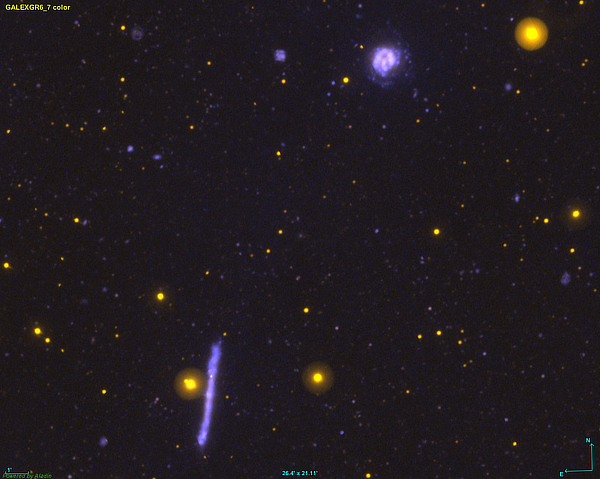
An ultraviolet wavelength image of galaxies NGC 2537 and IC 2233 in Lynx provided by the Galaxy Evolution Explorer (GALEX). NGC 2537 is a physically very small galaxy with a diameter of perhaps 20,000 light-years, much smaller than our Milky Way at 100,000 light-years. There are a large number of bright HII regions in NGC 2537 which give it its distinctive shape. There is another small galaxy catalogued as NGC 2537A about 5’ of arc away but this galaxy is likely to be in the background.
Visually NGC 2537 is likely to be a challenge, although there are reports of it being seen with a 5” telescope. I suspect that from UK skies probably 30cm will be needed, certainly to see any structure in it. NGC 2537 did not make any of the standard Astronomical League Herschel observing lists although it was added to the H300 list of faint galaxies. Both NGC 2537 and IC 2233 will fit in the same field of view at medium power (say 260x) but IC 2233 is very much fainter and will require good skies to find. I have seen both from the UK using my old 50cm telescope although IC 2233’s visibility depends very much on the sky conditions.
Owen Brazell - Galaxy Section Director
If you'd like to try out the Clear Skies Observing Guides (CSOG), you can download observing guide for the current Galaxy of the Month without the need to register. CSOG are not associated with the Webb Deep-Sky Society but the work of Victor van Wulfen.
-
NGC 2854 in Ursa Major
February 2026 - Galaxy of the Month

This interactive image of galaxies NGC 2854, NGC 2856 and NGC 2857 in Ursa Major was provided by the Sloan Digital Sky Survey (SDSS) using Aladin Sky Atlas. We also have a finder chart should help you locate these galaxies, as will this link for NGC 2854 on the Stellarium Web planetarium. For my choice of galaxies for the February GOM I have chosen the galaxy triplet NGC 2854, NGC 2856 and NGC 2857 in Ursa Major. The first two were discovered by William Herschel in 1788 but it took until 1856 that Mitchell using Lord Rosse’s 72” telescope at Birr found NGC 2857. He also noted the galaxy CGCG 238-051 (PGC 26694) next to it although Dreyer did not include that galaxy in the NGC.
All the galaxies are of spiral form with NGC 2857 being a face on spiral with a small well-defined core which explains its faintness. Herschel thought NGC 2854 and NGC 2856 were very faint as well.
The group were also catalogued by Arp with NGC 2854 and NGC 2856 coming under Arp 285 designation and NGC 2857 as Arp 1. With NGC 2857 Arp thought of it as part of his group of low surface brightness spirals and NGC 2854 and NGC 2856 were catalogued as a double galaxy with infall and attraction features.
The group are not physically associated, with NGC 2854/56 thought to lie at a distance of perhaps 40 Mpc and NGC 2857 almost twice as far away at 73 Mpc. The galaxies are also included in the galaxy group WBL 221, which contains 7 galaxies including NGC 2857, although as noted this galaxy is twice as far away as the others. NGC 2857 is also included in the 11 galaxy group LGG 168 (which does not include NGC 2854 or NGC 2856).
The strong UV signals shown in the GALEX observations from all three galaxies suggest that there is a lot of star formation going on in them. The UV observations also suggest tidal tails being drawn out from NGC 2854, probably from its interaction with NGC 2856. There is also possibly a string of material, originally thought to be a jet, being drawn out from NGC 2856 that is best seen in the UV as well, although there are signs of it on both the SDSS and PanSTARRS images as well. It is not however a jet but a series of star forming complexes. The material to form these would have been accreted from NGC 2854.
There are suggestions that on the larger cosmological scale these galaxies may be part of the galaxy filaments associated with the Virgo galaxy cluster.
The whole group is quite tight and will fit in the field of view of a modern hyperwide eyepiece at 265x. Perhaps as expected the group does not appear in any of the common lists although it is included in Alvin Hueys guide to Galaxy Trios available from his website. NGC 2857 has a small bright core and this is probably all that most people will see. Perhaps surprisingly as they are Arp objects they are not included in the The Night Sky Observer's Guide Vol. 2. Alvin Huey in his guide to the Arp objects suggests that in 22” Arp 1 is very faint with only a core seen. Arp 285 is much easier to see but no structure is visible. Those with larger telescopes or EAA systems might like to see if they can find PGC 26694.
Owen Brazell - Galaxy Section Director
-
NGC 936 in Cetus
January 2026 - Galaxy of the Month
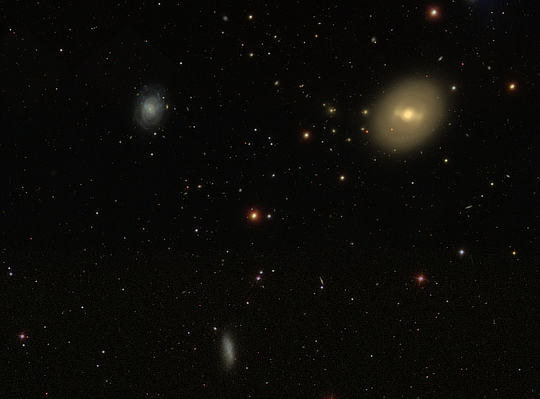
This interactive image of the NGC 936 and NGC 941 in Cetus was provided by the Sloan Digital Sky Survey (SDSS) using Aladin Sky Atlas. We also have a finder chart should help you locate these galaxies, as will this link for NGC 936 on the Stellarium Web planetarium. First discovered in 1785 by William Herschel the galaxy pair NGC 936 and NGC 941 in Cetus are an interesting combination of galaxy types.
William Herschel actually thought NGC 936 was a planetary nebula because of its shape and classed it in his Class IV objects. NGC 936 is actually a lenticular galaxy with a bar and shells whose shape has given it the name of the Tie Fighter or Darth Vader galaxy. There is a nice image of the galaxy taken by the VLT. NGC 941 is an open spiral galaxy classed as a Wolf-Rayet galaxy because its spectra reflects that of hot young stars.
If you compare images of the pair in the ultraviolet taken by the GALEX satellite, NGC 941 shows up as a large bright galaxy and NGC 936 hardly registers at all because there is no star formation going on in it. NGC 936 and 941 do not seem to be interacting. They also appear to be part of a small group of galaxies (LGG 60) which contains maybe 7 galaxies, including NGC 955. The group is associated with the M77 galaxy group. The distance to them is somewhat uncertain but NGC 936 appears to lie at a distance of perhaps 21 Mpc. Colour images show the differences between the stellar populations of the two galaxies as NGC 936 is yellowish as it consists mainly of old stars whereas NGC 941 is blue from all the young stars forming in it.
Historically NGC 941 is interesting because it was one of the galaxies that Halton Arp claimed was associated with high redshift quasars and this indicated they were ejected from the galaxy, a theory that has since been discredited.
The bar in NGC 936 is particularly pronounced but it is still not clear if the galaxy and its shape is influenced by a massive dark matter halo. NGC 936 was also home to the type Ia supernova SN2003gs, probably one of last supernovae to be discovered visually by Robert Evans using a 30cm telescope.
NGC 936 makes it into Stephen O’Meara’s The Secret Deep list as number 7.
Visually small telescopes in the range 20-22cm will show the core of NGC 936 but it will take larger apertures to see much of the detail that gives rise to its name. NGC 941 is going to be much more difficult to see and will show as just a faint irregular patch.
NGC 936 and NGC 941 are close enough together that they can be seen in the same field of view using a medium power wide field eyepiece. Steve Gottlieb suggests that both the NGC galaxies are visible in 20cm although they are better seen at 35cm.
Unfortunately, from the UK the pair do not rise much above the two airmass line so, although they can be seen with telescopes in the 20-22cm range from southern climes, I think that 30cm will be required from the UK.
Owners of large aperture telescopes may be able to pick up UGC 1945 which makes an equilateral triangle with NGC 936 and NGC 941 in the same field. It is much fainter at around 14th magnitude. UGC 1945 is actually physically associated with the other two. There is a nice amateur image of the group on astrobin.
Owen Brazell - Galaxy Section Director


