Double Star of the Month in Auriga
-
February 2026 - Double Star of the Month
About 10 degrees east of beta Aurigae lies a coarse cluster of mostly naked eye stars all bearing the label ψ (psi). The Cambridge Double Star Atlas (2nd edition) shows that ψ2, ψ5 and ψ7 are all double but they do not appear in the catalogue, presumably because they are all too wide. Nevertheless, 56 Aur = ψ5 Aur (06 46 44.34 +44 34 37.3), is worth looking at because it has a fine colour contrast.
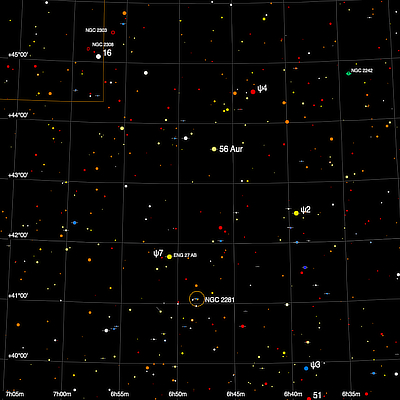
A finder chart for the double star 56 Aur in Auriga created with Cartes du Ciel. It was found by William Herschel in 1782 when the position angle (PA) and separation were 17 degrees and 53". and he noted colours of white and pale red. By 2022 the values of PA and separation were 44 degrees and 28" due mostly to a proper motion, largely in declination, of the A star. In 1970 I found the colours to be yellow-orange and blue with a 21-cm mirror.
Pi Puppis (07 17 08.56 -37 05 51.0) is a wide, unequal double star found by James Dunlop at Parramatta in New South Wales. It is about 8 degrees south of the blue supergiant eta CMa (V = 2.5). The primary is a very bright (V = 2.9) K4 giant whilst there is a V = 7.9 companion at 213 degrees and 69" with this separation slowly decreasing with time.
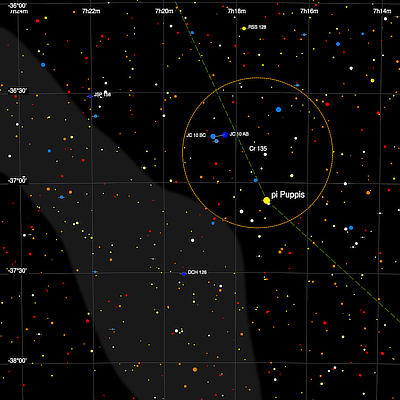
A finder chart for the double star pi Puppis in Puppis created with Cartes du Ciel. Gaia DR3 gives distances of 560 and 970 light-years respectively for A and B but the parallax measured for has a 20% error and this is because the Hipparcos mission in the early 1990s found that A itself was a double star with a V = 6.9 companion 0".7 distant. Since discovery this star has moved just 3 degrees but it does not appear in DR3.
Pi Puppis lies in a cluster called Collinder 135 which has six members brighter than magnitude 6. It might have had a common origin with a nearby cluster UBC 7. The centres of the clusters are currently 24 pc apart but the stellar motions indicate they would have been closer in the past.
Bob Argyle - Double Star Section Director
-
January 2026 - Double Star of the Month
The Hyades moving group contains stars which are not immediately proximate to the open cluster on the sky. The most famous is perhaps Capella, a bright spectroscopic binary with a 104 day period which is orbited by a binary pair of red dwarfs. Another member is ENG 22 (05 41 20.33 +53 28 52.7) which can be found 2.5 degrees WSW of delta Aurigae (V = 3.7).

A finder chart for the double star ENG 22 in Auriga created with Cartes du Ciel. It was catalogued by Rudolf Engelmann but recent measures by the Gaia satellite have revealed the parallax and proper motion of both components. The pair consists of stars of V magnitudes 6.0 and 8.9 which lie at a mean distance of 40.0 light-years and which are moving across the sky at 0".5 per year. The separation and position angle have remained fixed at 98" and 72 degrees so this is probably a binary system. The primary is a K dwarf and the companion has spectral type M0.
Adhara = epsilon CMa (06 58 37.55 -28 58 19.5), at V = 1.5, is the second brightest star in the constellation, but 4 million years ago, it was the brightest star in the sky reaching magnitude -4.

A finder chart for the double star eps CMa in Canis Major created with Cartes du Ciel. In the nineteenth century a visual companion was seen at the Cape Observatory, some six magnitudes fainter and 7".5 distant in position angle 167 degrees. Ernst Hartung noted that the the pair can be seen in 75-mm aperture, and that the primary is brilliant white whilst the companion is deep yellow.
The brightness of the primary is probably the reason why the error in the parallax found by Hipparcos is significantly larger than usual. Gaia has no results for this star but it is possible that the brightest stars in the sky will be investigated towards the end of the project. The satellite was switched off on March 27, 2025 and work on the Gaia DR4 catalogue is now in progress and the results are expected towards the end of next year.
Bob Argyle - Double Star Section Director
-
January 2023 - Double Star of the Month
STF 845 lies in Auriga (06 11 36.59 +48 42 39.6) and is also known as 41 Aurigae and it is also H 3 82, observed by William Herschel in November 1782 and recorded by him as
a pretty double star
. It is a beautiful pair for the small telescope. The writer first saw it in 1969 using the 12-inch reflector of a friend. At x208 the colours were noted as yellow and lilac. The Washington Double Star (WDS) catalogue gives the spectral types as A1V and A6V.
A finder chart for the double star STF 845 in Auriga created with Cartes du Ciel. James Dunlop found the 30th entry in his catalogue in 1826. It is located in Pictor at 06 29 40.03 -50 14 20.7 some 2.5 degrees NNE of Canopus. It offers a fine sight to the small telescope user.
The stars are magnitudes 6.0 and 8.0 and at present they are separated by 11".5, being 14" apart when observed by Dunlop. The position angle has hardly changed between these two epochs and is currently 312 degrees.

A finder chart for the double star DUN 30 in Pictor created with Cartes du Ciel. In 1871, Russell, observing with an 11-inch refractor at Sydney Observatory, found the primary star to be a close double. R 65 has a period of 111 years according to Docobo and Ling in 2021. The stars are almost equally bright but according to the orbit, which is extremely eccentric, the separation never exceeds 0".7 and, at times, drops to 0".012 which was the case in mid-2021. By 2027 the stars will be at least 0".4 apart.
In the 1890s Harvard Observatory was site testing in the Peruvian Andes and was using a 13-inch refractor. This telescope discovered several hundred new double stars amongst which was the fainter companion of DUN 30. This has also turned out to be a binary pair of period 101 years, giving a predicted position of 224 degrees, 0".44 in early 2023. The stars have visual magnitudes 8.0 and 8.7.
Bob Argyle - Double Star Section Director
-
December 2019 - Double Star of the Month
14 Aurigae (05 15 24.39 +32 41 15.3) sits in a small cluster of naked-eye stars 5 degrees north and a little preceding beta Tauri. It was first found by William Herschel on 24 September 1780, who called it H IV 19. He gave the colours as reddish-white and dusky but by the time that F. G. W. Struve had observed the system the colours had become greenish and blue.
Struve also added a fainter companion B of magnitude 10.9 at 11 degrees and 9".8 whilst the Herschel companion was reclassified as C. There is an additional 10.8 magnitude star at 180". The writer measured AC in early 2016 at 225 degrees and 14".5.
Hubble Space Telescope (HST) observations of star C have shown the existence of a white dwarf companion 2" away but 7 magnitudes fainter than C in the V band. There are no confirming observations to attest that the white dwarf is a physical member of the system, but if it is then 14 Aur is quintuple as both A and C are spectroscopic binaries and C is attached to A.
A low power field also includes 16 Aurigae, a considerably more difficult pair found by Otto Struve in 1848. The Washington Double Star Catalog (WDS) gives magnitudes of 4.8 and 10.6 whilst the position of B has changed little relative to A. In 2009 it was at 55 degrees and 4".1. This implies a physical relation as the primary star, a K3 giant has a proper motion well in excess of 0".1 per year. Gaia DR2 shows the B star but is coy about it's parallax and proper motion.
BU 311 (04 26 56.93 -24 04 52.8) lies in an extensive sparse area of Eridanus about 10 degrees west of Lepus. It was found by S. W. Burnham with his 6-inch refractor on 24 October 1874, who estimated the distance at 1". Burnham noted that there was
uncertain change
by the time he compiled his General Catalogue (1906).Since then the companion has passed through periastron and is now on the opposite side of the apparent orbit at half the discovery distance. The period is 596 years and the stars will remain close for some years to come. The ephemeris for 2020.0 gives 162 degrees and 0".4. The magnitudes are 6.7 and 7.1, so about 30-cm will be needed to divide these stars.
Bob Argyle - Double Star Section Director
-
January 2016 - Double Star of the Month
STT 147 (06 34 19.37 +38 04 33.6) is located in Auriga and is about 35 arc minutes south preceding the very red star UU Aur which is visual magnitude 5.3 and has an exceptional B-V colour index of +2.6. The field can also be found from the bright binary theta Aurigae by moving about 9 degrees due east. Burnham describes it as an almost equilateral triangle with the sides being about 40" long and the stars A, B and C being respectively 6.8, 8.7 and 9.9. Sissy Haas notes that A is
bright orange
and indeed the spectral type of this star is K0.When the pair was first observed by Otto Struve at Pulkovo he also noted that C was a very close and difficult pair. The WDS gives the magnitudes as 10.6 and 11.0 with PA 109 and separation 0".5. There seems to be little motion in this system. Burnham notes that it was 'difficult' in the 18.5-inch Dearborn refractor and no measures have been made since 1957.
So here is a challenge for the larger aperture user and a real test of the seeing and transparency. Another neat pair (STF 928) can be found 27' north following, mags 7.9 and 8.6 at 131 degs and 3".5. These stars have common proper motion and appear to form a binary pair. An unconnected mag 12.4 can be found at 124 degs and 131" to B.
HJ 3857 is in Columba (06 24 01.02 -36 42 28.4) about 2.5 degrees south following the 4.4 magnitude kappa. This is also an easy triple although star B did not appear to Dunlop when he recorded this pair as number 28 in his catalogue, but was swept up a few years later by John Herschel at Feldhausen.
The WDS catalogue values for the magnitudes are 5.7 (A), 9.8 (B) and 6.9 for C. The Dunlop component would appear to be a field star and has moved 6" closer to the closer pair over the last 2 centuries or so. Gould, using 175-mm, notes that the primary is orange and the wider companion is bluish.
Bob Argyle - Double Star Section Director
-
January 2015 - Double Star of the Month
STF 644 in Auriga (05 10 18.81 +37 18 06.7) is a pair noted for the contrasting colours of its components. The spectral types of the two stars are respectively B2II and K3 and when W. H. van den Bos observed the pair with the Lick observatory 12-inch refractor in 1962 he noted the colours were white and reddish. E. J. Hartung noticed this colour disparity too - he found orange amd white with 10.5-cm aperture adding
if merely elongated the appearance of the ellipse is striking with one end orange and the other white
. Sissy Haas on the other hand with 125-mm at x200 found both stars to be yellow-white.This is a close pair which has remained virtually motionless since it was discovered by F. G .W. Struve. The magnitudes are 7.0 and 6.8 with the orange component being slightly brighter visually. G. van Biesbroeck added a distant mag 10.5, K3 dwarf at 192 degs, 72". To find STF 644 look about 1.5 degree south of mu Aurigae. It is the preceding of two mag 6 stars - the other being the unequal wide pair SEI 105 (6.5, 11, 27 degs, 35"), about 1 degree following.
HJ 3683 (04 40 17.72 -58 56 39.5).
Very fine
noted John Herschel from South Africa in 1836 when he first laid eyes on this pair of stars and gave them both magnitude 8. The WDS catalogue says they are 7.3 and 7.5 but the main interest lies in the nature of the apparent orbit of this 326 year binary. The high inclination means that motion is restricted to a narrow range of position angles and so mainly manifests itself in separation, whilst the very high eccentricity (0.95) means that the maximum separation is 4".3 whilst the minimum is only 0".03 which, given the Hipparcos parallax of 32.77 mas, indicates that the two stars are only 3.7 AU apart at periastron but 144 AU apart at apastron. When at their nearest separation the position angle changes by 1 degree per day, almost 5 times faster than that managed by the two components of gamma Virginis at periastron.The pair is currently at 3".7 and so is an easy object for the small telescope. Gould with 175-mm calls both stars yellow and the pair can be found about three degrees south and slightly following alpha Doradus.
Bob Argyle - Double Star Section Director
-
Double Star of the Month - January 2013
In this series of short articles, a double star in both the northern and southern hemispheres will be highlighted for observation with small telescopes, with new objects being selected for each month.
26 Aurigae (STF 753 - 05 38 38.10 +30 29 32.8) is one of William Herschel's class III double stars, and can be found about 3 degrees north-following beta Aurigae. It is a bright and easy pair - the two main stars being visual magnitude 5.4 and 8.4 and the companion 12".2 distant from A. Smyth found the stars to be pale white and violet whilst Sissy Haas notes straw yellow and atlantic blue. It seems likely that this is a physical pair but the same cannot be said of the unassociated star of V = 11.5 which is slowly increasing its distance from A and can be found at 113 degrees and 35". Burnham found it independently in 1872 but noted that it had already been found by Morton using the 7.75-inch refractor at Lord Wrottesley's observatory some 10 km north-west of Wolverhampton. In 1892 Burnham found that the primary was an almost equally bright close pair and indeed it turns out to be a binary with a period of 53 years (BU 1240). At present it is just beginning to close and at 0".2 will require considerable aperture and excellent seeing.
Five degrees following epsilon Col is a wide (13 arc min) pair of stars which make up an easy binocular double and may just be visible to the naked eye. This is gamma1 (V = 4.7) and gamma2 Caeli (V = 6.3). There is much more here for the telescopic observer to note, because both these stars are again double. Gamma1 (05 04 24.40 -35 28 58.7) somehow missed the attention of John Herschel and was swept up by Captain Jacob in 1847. The companion at magnitude 8.2 is currently 3".2 distant in position angle 305 degrees. There is slow retrograde motion and the distance is gradually increasing. The primary is a K3 giant and indeed Hartung notes the colour to be orange, with the companion white. Gamma2 was discovered to be a close unequal pair by the Hipparcos satellite and is now called HDS658. The companion (mag 9.7) is 0".9 away in position angle 195 degrees - there has been about 12 degrees of motion since discovery. This star should be visible in 30-cm on a good night. Both gamma1 and gamma2 are in Hipparcos but gamma1 has a parallax of 17.90 mas whereas that of gamma2 is 10.15 mas.
Bob Argyle - Double Star Section Director
-
Double Star of the Month - January 2010
In this series of short articles, a double star in both the northern and southern hemispheres will be highlighted for observation with small telescopes, with new objects being selected for each month.
Lying about 4 degrees following iota Aur, the fainter of the stars in the horns of Taurus, is 14 Aurigae = STF 653 (05 15 24.39 +32 41 15.3) a bright and easy pair (magnitudes 5.01 and 7.33) currently separated by 9".8. Good nights in small telescopes may also reveal the fainter (11.0) component C at a similar distance and first seen by F G W Struve, although Sissy Haas did not see it in 12.5-cm. Lewis in his work on the Struve stars (1906) lists a number of colour estimates for the two components - Dawes: yellow and blue, Smyth: pale yellow and orange, Dembowski: yellow and blue, Duner: yellow and azure, and Perrotin: white and orange. More recently, Haas notes it as bright straw yellow and royal blue. The system as a whole is a complex one. A is also a spectroscopic binary and a delta Scuti variable known as KW Aur. C is thought to be physical, whilst B merely reflects the proper motion of A. However, C itself is a spectroscopic binary and HST observations have recently established the presence of a white dwarf companion (Cb) 2" away whose connection to Ca has not been established. 14 Aur A lies at a distance of 286 light years.
kappa Leporis (05 13 13.88 -12 56 28.7), whilst certainly in the southern hemisphere, tantalizes the northern observer as the constellation below the feet of Orion can be seen briefly as Orion culminates. Many of the doubles noted in Lepus by Webb are unequal and this pair is no exception - A and B are respectively 4.43 and 6.99 according to Makarov and Fabricius in their analysis of Tycho-2 magnitudes) but also the relative close separation (now just under 2", having been closing since discovery in 1832). The writer has measured it with 20-cm but the seeing more than 60 degrees from the zenith is rarely good. Hartung reports that it easy with 7.5-cm from Australia. The primary is a late B dwarf but Smyth recorded pale white and clear grey for 1835 whilst Webb notes colours of yellow and grey in 1851.
Bob Argyle - Double Star Section Director
-
Double Star of the Month - January 2009
In this series of short articles, a double star in both the northern and southern hemispheres will be highlighted for observation with small telescopes, with new objects being selected for each month.
This months column features two stars which are, nominally at least, the 7th brightest in their respective constellations. Theta Aurigae = STT 545 (05 59 43.24 +37 12 46.0) is one of Otto Struve's discoveries at Pulkovo using the 15-inch refractor in 1852 but there are no measures on record until 1871. Orbital motion is slow but retrograde and covers some 60 degrees over the last 130 years. The separation has very slowly increased from 2".1 to the present 3".8. Whilst this may appear to present no problems to the small telescope user, the difference of magnitude certainly does and this system is one of the classic tests for the small aperture. The WDS gives the magnitudes as 2.6 and 7.2 so its not just the brightness difference but the glare from the primary star that has to be dealt with. However, it is the case that small apertures tend to work better on this star than larger ones as the quality of the atmosphere is also an important consideration when observing it. The writer finds it difficult to measure in an 8-inch refractor when the red field illumination of the micrometer is switched on. Theta Aurigae is about 165 light years from the Sun.
Theta Pictoris = DUN 20 (05 24 46.29 -52 18 58.2) was observed by John Herschel in 1835 and noted to be a `fine' pair. It had been discovered by Dunlop in 1826 and whilst Hartung refers to the two components (visual magnitudes 6.24 and 6.74) as pale yellow, the WDS catalogue lists the spectral types as A0V and A2V. In the last 180 years there has been virtually no relative motion between the two stars and the system is ideal for use as a calibrator for filar or eyepiece micrometers (2010.0: 287.6, 38".14). In 1901 Robert Innes found that A was itself a close pair and the system is a difficult one for any but the largest visual telescopes with the current separation not exceeding 0.2 arc seconds until 2010. It then widens to about 0".46 in 2079, the period being 191 years. There are reasons to believe that theta Pic is in fact a quintuple system. One of the stars in the close pair is a spectroscopic binary and the distant companion is also suspected of variable radial velocity. The group is remote with the revised Hipparcos parallax giving the distance as 512 light years with an uncertainty of 25 light years.
Bob Argyle - Double Star Section Director


