|
Price Lists |
|||||||
|
Bulletin Board
****The Webb Deep-Sky Society 2012 AGM will be held at the Institute of Astronomy (IoA) in Cambridge on Sat 16th June 2012**** Click here for directions to the IoA Confirmed Speakers so far: Prof. Katherine Blundell - Distant Galaxies, Jeff Young - Experimental Visual Observing, Dave Adshead - Deep Sky Imaging from the Kingfisher Observatory. Bob Marriott - The Life of Dawes, Owen Brazell - Observing Distant Galaxy Clusters.
Doors Open 10:00 with Coffee. AGM Starts 10:30. Talks Start 11:00. Entrance Fee £10 to Include Lunch, Tea / Coffee etc. The Meeting will Finish Around 17:30
|
|||||
|
May 2012 - Picture of the Month The Double Star 'Albireo' in Cygnus Image Courtesy of Bob Franke Chino Valley, AZ Click on image for a larger version Bob's Observation Notes:- "Albireo is a beautiful gold and blue double star in the constellation Cygnus. It is still unknown if Albireo is a gravitationally bound binary system or simply a chance alignment optical double. At a distance of 380 light-years, and with a separation of 35 arcsec, the possible orbital period is at least 75,000 years. Given this long orbital period, it will probably take several hundred more years to determine the nature of this double. In 1976, gold colored Albireo-A was discovered to be a binary star, with a separation of only 0.4 arcseconds. Albireo-B is a fast rotating blue-green star with a surface temperature of about 13,200 K. Although much about this double is unknown, we know that is a truly magnificent sight, when viewed with a telescope. Even the smallest of backyard telescopes will reveal Albireo's beauty. [Comment: North is to the top]." Instrument: 12.5" RCOS @ ~f/9 (2880 mm fl) 1.28 arcsec / pixel. Mount: Paramount ME Camera: SBIG STL-11000 w/ internal filter wheel, AstroDon Gen I Filters Acquisition Data: 9/4/2010 to 9/8/2010 Chino Valley, AZ. with CCDAutoPilot3 & CCDSoft. AOL guided Exposure: RGB 225 min (15 x 5 min each, bin 2x2) Software: CCDSoft, CCDStack, Photoshop CS, Noel Carboni's actions and Russell Croman's GradientXTerminator. eXcalibrator for (b-v), (v-r) color calibration, using 19 stars from the NOMAD1 database. PixFix32 (pre-beta) to repair hot/cold pixels and column defects. CCDStack to calibrate, register, normalize, data reject, combine the sub exposures and RGB color. PhotoShop for on-linear stretching.
Bob has developed the following 'freeware' astrophotography programs which are available to download on his 'My Freeware' Link PicFix uses the CCDSoft routines to repair columns or pixels in selected files or an entire folder. ezSkyView provides an easier user interface for NASA's SkyView Query Form (SQF), to create images of astronomical objects or specific portions of the sky. This allows the astrophotographer to quickly see, in advance, how an intended target will look on his computer screen. Another use is for creating images to include in your planetarium program, such as TheSky6. eXcalibrator calibrates image color by using the NOMAD1 or SDSS database to identify stars in your image that should be white. The program then computes the correction factors to apply to the green and blue channels. For more images from Bob please visit his Focal Pointe Observatory website. Deep-Sky Observer (DSO) No 153 - Free Sample
The free journal is DSO 153 from 2010 You can download it as a PDF file onto your computer by right clicking the link below and choosing either 'Save Target As' or 'Save Link As'....
Download DSO 153 (2MB PDF file)
|
May 2012 - Galaxy of the Month - NGC 4449 Image copyright R Jay GaBany;Inset by: R. J. GaBany (Blackbird Observatories), Aaron Romanowsky (UCSC) & and Jacob Arnold (UCSC) in collaboration with D. Martínez-Delgado (MPIA); National Astronomical Observatory of Japan (NAOJ) Click on image for a larger version The dwarf irregular galaxy NGC 4449 is part of the M94 group of galaxies in Canes Venatici. Also known as the Canes Venatici I group this is a loosely bound group of galaxies that is one of the nearest groups to our own. The brightest member of this group is M94, although M106 has also occasionally been suggested to be part of this group. NGC 4449 is dwarf irregular galaxy similar to the Large Magellanic cloud and like the LMC appears to be undergoing vigorous star formation (See NASA APOD 25th Feb 2011). The cause of all this activity may have been a recent interaction with the dwarf galaxy DDO 125 (UGC 7577) which currently lies about 38’ south of NGC 4449. The age of the stars in the central bar is thought to be not much more than 5 million years or so. NGC 4449 is thought to be less than 20000 light years across and about 12 million light years distant. It is however also surrounded by a much larger halo of neutral hydrogen gas. First discovered by William Herschel in 1788 it is visible in telescopes as small as 8cm and because of its distinctive shape has become known as the Box galaxy. Recent deep images of the galaxy have shown that even small galaxies like NGC 4449 can grow by merging with other galaxies and the remnants of such a merger are shown by a faint tidal stream of stars (sometimes catalogued as NGC 4449B). This is thought to be the remnant of a massive dwarf spheroidal galaxy from the type of stars in the steam and will deposit as much material again as is already in the halo of NGC 4449 (See NASA APOD 26th Jan 2012). Interestingly this faint companion was independently discovered by two teams of astronomers both using amateur collaborators for the deep wide field images. Due to its proximity NGC 4449 has been well studied by the Hubble space telescope (See Hubblesite Tour - NGC 4449). Observations recently made at the Kelling Spring star party of this galaxy using Andrew Robertson’s 24” suggest a better moniker for this galaxy might be the Lobster galaxy as coming out from the box shape are two claws. The upper one was well defined and appears in images as a row of HII regions but the lower was perhaps best defined by one large spot, which is also an HII region. The main part of the galaxy itself also shows a mottled form which is from the various star forming regions. Much of this detail has been reported with much smaller telescopes and indeed Herschel himself was able to resolve structure with his 18.7” speculum which is probably equivalent to a modern 25 cm telescope. Unfortunately at the time we were not aware of the UGC companion so did not seek it out. DDO galaxies do however tend to be low surface brightness objects so it is not clear we would have seen it. There are also numerous observations of 4449 in WSDSOH Volume 4 with telescopes up to 36”. Owen Brazell - Galaxy Section Director For more images from R. Jay GaBany please visit his Cosmotography website. May 2012 - Double Star of the Month Nine degrees south of Arcturus is 15 Boo - a naked eye star which is a difficult double star for the small aperture but which can be well seen in a 20-cm OG on a good night. Track another 3 degrees south-east and the eye alights on a crooked line of 3 stars with the brightest of them being the most northerly. This star is STF1835 (14 23 22.74 +08 26 47.8) and because it is almost half a magnitude brighter than 15 Boo it is unusual in that it has no Bayer number or Flamsteed letter. For the small telescope the pair offers a very pleasing sight with an AO primary being accompanied by an F2 secondary some 6" away to the south. Hartung makes the colours white and deep yellow, Sissy Haas has goldish-white and powder blue whilst W. S. Franks in 1916 made them white and lilac. Angular change has amounted to 7 degrees in the last 230 years but it seems certain that the two stars are physically connected. In 1889 Burnham found that B was a close double (BU 1111) and indeed it turns out to have a binary period of 40 years. The separation ranges from 0".15 to 0".3 so could be seen in 30-cm or more when at its widest in 2022. For 2012.0 the distance is 0".2.
About 3 degrees following beta Crucis, although actually in Centaurus, is a group of bright double stars - R 213, I 424 and CorO 152 - the latter two of which are in the same field. I 424 (13 12 187.63 -59 55 13.9) is a very unequal and rather close pair which needs 20-cm on a good night to see well, but which Hartung could just catch with 10.5-cm. The magnitudes are 4.8 and 8.4 and a recent measure in 2008 by the writer put the fainter star at 13° and 2".0. For the larger aperture, the primary is the binary See 170 - discovered by Thomas Jefferson See and which is only 0".22 apart in mid-2012. This 27 year pair has components of 5.3 and 6.0. Hartung notes that the primary star is yellowish but it has the spectrum of a B5 dwarf. Some distance from AB-C are two faint companions of magnitudes 12.6 and 14.9. About 8' NE is CorO152 - a 25" pair with colours of orange and reddish according to Hartung. R213 is a pair of white stars of magnitude 6.6 and 7.0 which has moved little in PA since discovery by Russell but the separation has tripled to 0".9 and this makes it an excellent test object for a 12-cm aperture. Bob Argyle - Double Star Section Director |
||||
|
Two Recent Deep-Sky Images from Paul Brierley, UK
Paul's Observation Notes:-
"Last night, [Sat 14th April 2012]
from 9pm onwards. We had here in East Cheshire a lovely, clear sky,
and I was able to use my new, imaging set up, for the first time.
Regards Paul A Brierley. Observing Co-ordinator Macclesfield Astronomical Society Blogspot Web Album Peak Star Party
|
|||||
|
The Brightest Planetary Nebulae Observing Atlas Courtesy of Massimo Zecchin - Italy Massimo has just completed an atlas of planetary nebulae observed with small apertures and from suburban locations, entitled: "The Brightest Planetary Nebulae Observing Atlas". The atlas is freely available in two versions, Black (for display) and White (printer friendly with the images in negative). Each of the the sketches in the atlas contains a map showing the object. The maps are taken from Toshimi Taki's Star Atlas who has kindly given his consent for them to be used for the atlas. Both atlases can be download as a PDF files onto your computer by right clicking the links below and choosing either 'Save Target As' or 'Save Link As'....
|
|||||
|
Planetary Nebulae Sketches NGC 6720(M57), NGC 7293 and NGC 7662 Courtesy of Massimo Zecchin - Italy Click on image for further Planetary Nebulae Sketches and Massimo's Observation Notes |
|||||
|
Latest Deep-Sky Observer - DSO156 Annual Meeting Report 2011 Bob Argyle Object of the Season: NGC 6765 Wolfgang Steinicke Next Northern Object of the Season Wolfgang Steinicke The IC 2375 Galaxy Group Ronald J Morales Using a Nikon D40 for Astro Imaging Paul Brierley The Identification of SS Virginis Mike Swann Winter Doubles Andrew Robertson Book Reviews The Cambridge Atlas of Herschel Objects James Mullaney and Wil Tirion Reviewed by Dave Adshead The Complete Guide to the Herschel Objects Mark Bratton Reviewed by Andrew Robertson Kelling - Spring 2012 Report An Article by Owen Brazell "This year’s Kelling Heath Spring party was beset by all sorts of poor weather from rain, sleet and hail through wind. As the forecast was so poor I elected not take my 22 but the 15 got a ride out. Actually it seems that from my point of view the Spring star parties usually have poor weather as the 15” came last year as well. Despite a relatively low turnout because of the weather a few hardy souls did brave the conditions to get some clear sky on the Saturday that was mostly spent chasing holes in the cloud before the rain returned. I had managed to get setup by midnight as the clouds cleared on Saturday I looked at M13 and Saturn as well as M92. I was trying to see IC 4617 but missed out. The Sunday night however was much better as it cleared about 11:30 and remained mostly clear until dawn with a few cloudy intervals. I spent most of this time with Andrew Robertson and his 24” We started with some of the show piece objects including M51. When viewed through the 8mm Ethos the detail seen in the spiral arms and the companion were extremely good. I could see many of the bifurcating spiral arms that John Herschel drew as well as many HII regions and star clusters. It truly was looking at individual objects in an external galaxy. We then moved onto M101 with a 21mm Ethos eyepiece. The view here was almost photographic with the galaxy set in a nice star field. We then moved down to the 13mm Ethos and spent some time looking at the HII regions here before Andrew noticed a small spot off the edge of the galaxy. This turned out to be NGC 5471. We thought as it was not connected with any of the spiral arms that it must be another galaxy but further research during the light of day suggested that it is an isolated HII region associated with M101. Moving on to NGC 4490 or Arp 269 with the 8mm we could see the hook like extensions and disturbed sections of 4490 and also some of the shape of 4485. We both thought we could see an extension joining the two but there is none and it shows how the eye can be fooled into seeing features that were not there. A quick break from galaxies led us to M97. The central star here was seen about 60% of the time but what was more interesting was that even without a filter we could see some of the outer halo along with the normal round section. Our next target M108 was one of the more interesting targets as it did not really look like a galaxy but a string of knots with no obvious centre. M81 showed all of its spiral arms but no obvious sign of Holmberg IX, the dwarf galaxy near it. The size of the galaxy meant we stayed with the 13mm Ethos. Moving onto M82 and upping the power to use the 8mm showed the dark lanes and distorted sections of the galaxy filling the field. We then had a look at M13 and I was surprised that the view was not spectacularly better. N6207 showed a lot of detail but I still could not find IC 4617. We also looked at M92. Our next target was the box galaxy NGC 4449. I thought this should be the galaxy symbol of the star party as it looked like a lobster (Cromer is famous for its crabs and lobsters). The northern section showed up well with some structure whilst the lower claw was really only defined by a spot (HII region ) at the end of the claw. We did see some mottling in the galaxy as well. This was of the surprises of the night. Before it set too much we moved on to the whale (4631) and calf. These were relatively disappointing compared to what had gone before. We moved then to the Hockey stick galaxy (N4656). Here we were surprised by the detail in the main part of the galaxies with the condensations including N4657 showing up well. What was more interesting was the fainter extension that showed up well even with direct vision. We then took another break from galaxies to look at M57 and really cranked the power up using a 4.7mm Ethos (x590) and here the central star was seen most of the time by both myself and Andrew along with another observer. As some high haze was moving in we had brief looks at NGC 6888 and the Veil complex which looked pretty much 3D. Our final object of the night was NGC 6543, the Cats Eye nebula in Draco. Here we had some of our best surprises. Even without a filter IC 4677 was obvious (IC 4677 is part of the extended halo). Andrew tells me that with a filter some of the rest of the halo can be seen but we did not try this. We then put the 4.7 back in to look at the central part and were amazed by the structural detail that was visible. In moments of good seeing it looked filamentary with the hooks appearing relatively easily. All in all worth braving the storms and waiting the extra night. My thanks to Andrew for allowing me to observe with him. Even with the high cloud we still had a decent night and I am now spoilt and hope that the 22” will show a fraction of this. The 24 “ now after much trials and tribulations appears to have excellent Mirror by Es Reed."
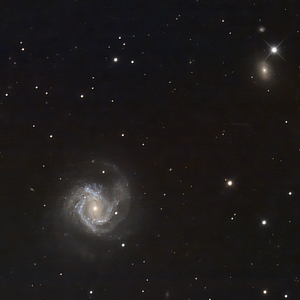
Owen Brazell - Galaxy Section Director Hickson Project Article by Owen Brazell Hickson 44 Image Courtesy of Sheldon Faworski and Sean Walker Click on image for a larger version In 1982 Paul Hickson published a paper containing a set of compact groups of galaxies numbering 100 that he had found whilst studying the POSS prints. The Atlas was also produced in book form in 1993 by Gordon and Breach with images for all the galaxies. Although this has been long out of print second hand copies can still be found on Amazon. These galaxy groups have been much studied by professionals because of the fact that they have a rigorously defined set of parameters which makes them useful for looking at the dynamics and evolution of galaxy groups. The catalogue also contained a number of well known objects, such as Stephan’s Quintet which made it interesting for amateurs looking for new challenges. Hickson himself wrote a review of the status of these objects in 1997. As this catalogue became more well known to the amateur community various people produced guides to observing them including Alvin Huey and Reiner Vogel. There are also fine webpage's which include observations of various members of this catalogue. Bearing this in mind, and that there is a limited range of 100 objects, Stewart Moore and I thought that observing the Hickson catalogue might make a nice joint observing project for the British Astronomical Association Deep Sky Section and the Webb Society galaxy section to collect observations and images of as many of these groups as we can with the intention of putting a paper together for DSO and /or the BAA Journal. The galaxy groups here range from challenges for small telescopes (here we define small as 20-22cm) where you may be able to see the brighter members of some of the groups down to challenges which will probably require very large telescopes from dark sites to see at all visually. However because of the rise of CCD imaging I would imagine that most of these objects should be gettable with relatively small instruments, although image scale may be an issue as some of these groups are quite small in angular size. In the past observing projects have not proved very popular in the Webb Society, certainly amongst UK based observers, and the fact that the catalogue was generated from the POSS prints means that a number will not be visible for southern hemisphere observers and means that we may yet be relying on our North American colleagues for some of these observations. As a helping hand for those observers who have either SkyTools 3 or AstroPlanner V2 (beta) I have included a couple of plan files one for each package (The SkyTools one contains images for each group) You should be able to download these and import them into the programs. The .stx file is for SkyTools and the .apd file is for AstroPlanner. Click here to download the files. Owen Brazell - Galaxy Section Director |
Object of the Season - Summer 2012 & Autumn 2012 The Webb Deep-Sky Society Nebulae & Clusters Section Director Wolfgang Steinicke has requested observations for the following deep-sky objects:-
Object of the Season (Summer 2012): Planetary Nebula NGC 6765 in Lyra Details will shortly be published in DSO156 and the results are scheduled to be in DSO 158 Click here for Object Details
Object of the Season (Autumn 2012): Open Cluster NGC 7789 in Cassiopeia Details will shortly be published in DSO157 and the results are scheduled to be in DSO 159 Click here for Object Details
NGC 6765 NGC 7789 Click on images for a larger versions The complete schedule, including further objects, is published in the Deep Sky Observer (DSO). Observations should be sent to: steinicke-zehnle@t-online.de Two Methods of Recording the Recent Deep-Sky/Solar System Configuration of Comet Garradd and the Globular Cluster M92 in Hercules Click on individual images for larger versions Image Credit - Dave Eagle, UK For more images from Dave please visit his Eagles Eye on the Sky website
Sketch Credit - Dale Holt, UK Further sketches from Dale can be found at his Chippingdale Observatory website Date for your Diary! Peak Star Party 2012, 19th - 22nd October Huge 20m x 20m (60ft x 60ft) marquee to host talks, workshops and stay dry, no matter what the weather! All weekend catering. Exact details tbc but we are hoping to run catering from 10am to 6pm, to include breakfast, dinner and snacks. Snack and drinks tent available at all times - hot and cold drinks and some snacks available through the night for day visitors. Click here for further details.
An Arp (Arp94), a Hickson (HCG44), and a Supernova SN2012aw A selection of Sketches Courtesy of Jeff Young Click on image for larger versions and Jeff's Observation Notes Further sketches from Jeff can be found at The Observatory at Rokeby Hall |
||||
|
The Webb Deep-Sky Society Star Atlas This is the most detailed and accurate Atlas in its class! The Atlas comprises of 44 star charts (inc. Notes and Measuring Guide) covering the whole sky to magnitude 7.1 Two Versions are Available - Colour and Monochrome For details on how to order the Star Chart click the 'Price Lists' button at the top of this page Click on image for a larger version of Chart No. 26 |
|||||
|
A Selection of Deep-Sky Sketches from Dale Holt Sketches Courtesy of Dale Holt, from his Chippingdale Observatory ![]() Click on sketch larger versions and Dale's Observation Notes. |
|||||
|
Warning - Bank Charges If you intend to purchase a DVD and/or publication from The Webb Deep-Sky Society via bank transfer and you are outside the UK then please check what the bank will charge for this transaction. We know of a least one bank abroad that charged 90% of the cost of the item to use their services. |
|||||
|
If you have any comments or problems with this page or any other Webb Deep-Sky webpage then please contact the Website Administrator The Webb Society is registered under The Charities Act 1960 - Registered Charity No. 288384 © 1996 Webb Society except where stated. |
|||||
|
The information contained in this website is for general information purposes only. The information is provided by The Webb Deep-Sky Society and while we endeavour to keep the information up to date and correct, we make no representations or warranties of any kind, express or implied, about the completeness, accuracy, reliability, suitability or availability with respect to the website or the information, products, services, or related graphics contained on the website for any purpose. Any reliance you place on such information is therefore strictly at your own risk. In no event will we be liable for any loss or damage including without limitation, indirect or consequential loss or damage, or any loss or damage whatsoever arising from loss of data or profits arising out of, or in connection with, the use of this website. Through this website you are able to link to other websites which are not under the control of The Webb Deep-Sky Society. We have no control over the nature, content and availability of those sites. The inclusion of any links does not necessarily imply a recommendation or endorse the views expressed within them. Every effort is made to keep the website up and running smoothly. However, The Webb Deep-Sky Society takes no responsibility for, and will not be liable for, the website being temporarily unavailable due to technical issues beyond our control. |
|||||