These are our observations in Scutum
-
Three in one: NGC 6712, IC 1295 and PK 25-4.1
The attached image resulted from something of an experiment to explore what quality of image I might get from using the ASI 294MC Pro one-shot-colour camera to try and capture two low-down, planetary nebulae.
My attention was initially drawn to the globular cluster NGC 6712, but an exploration of that region of the sky with a Cartes du Ciel revealed the planetary nebula IC 1295 close by with the Perek-Kohoutek object, PK 25-4.1 close by. I, therefore, elected to try my RC10 telescope with a 0.7x reducer (finally at its correct spacing) and with the telescope recollimated following some incorrect assumptions concerning the pointing accuracy of my TS_Optics focuser.
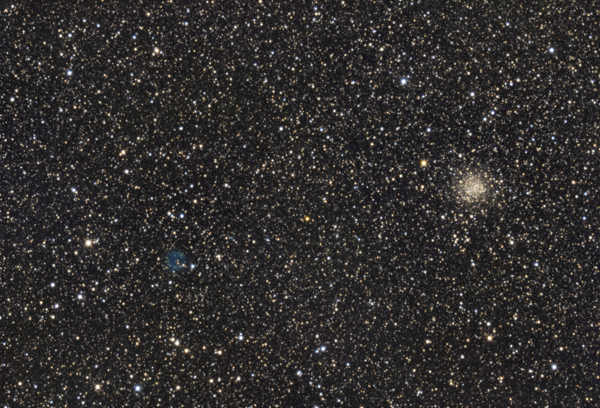
A 2x2 binned image of the globular cluster (NGC 6712) in a rich field of stars to the right of the image and IC 1295 to the lower left of the centre by David Davies. Taken from Cambridge in the UK. To see more of David's work please visit his Flickr Photostream. Click on the image for the larger version. NGC 6712 was discovered by William Herschel on June 16th, 1784. It is a relatively small (64 light-years across) and sparse (~1 million stars) globular cluster, which lies 22,500 light-years away.
A study by the European Southern Observatory concludes that NGC 6712 is only a pale remnant of a once much more massive cluster. It notes that none of NGC 6712’s stars is less massive than our Sun, making it totally unlike any globular cluster. Most likely, NGC 6712 is unique only because no other globular cluster comes as close to the Milky Way’s centre as NGC 6712; it penetrates very deeply into the galactic bulge, venturing to within 1,000 light-years of the galactic centre. The tidal force of the galaxy not only strips low-mass stars from the cluster but also stretches out the cluster like a comet’s tail. The ESO study labels NGC 6712 as a peculiar globular cluster. The Interstellarum Deep Sky Atlas labels 6712 as The Weird Globular.
Above is my 2x2 binned image of the full field which shows the globular cluster in a rich field of stars to the right of the image and IC 1295 to the lower left of the centre. I think I can see streams of stars running east of north and west of south from the globular cluster, as described in the literature.
Below is a full-resolution image of the region around IC 1295. IC 1295 is slightly left of the centre, and I believe that PK 25-4.1 is the small bright blue object in an arc of four stars to the upper right of the centre.
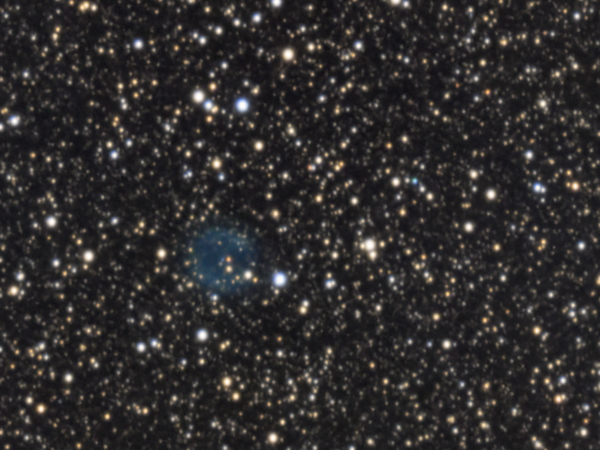
A full-resolution image of the region around IC 1295 by David Davies taken from Cambridge in the UK. Image Details
Data: 60 x 2-minutes exposures from 2nd to 6th October 2022.
- Telescope: 10-inch Ritchey Chretien with a x0.7 reducer at 1400mm focal length
- Camera: ASI 294MC Pro (-15C, gain 120, off 13)
- Mount: Skywatcher EQ8
- Software: NINA, Pixinsight, Photoshop
David Davies - (10 October 2022).
-
M11 in Scutum
I ventured out in the nautical twilight of 31 July and explored the region around Messier 11, the Wild Duck Cluster.
I recall observing this beautiful object, visually with an 80mm ED refractor whilst on holiday under the dark skies of Guernsey and was mesmerised by the sight of this compact cloud of young blue stars against the multitude of older, redder stars close to the core of our galaxy.
The clear night of 31 July, despite the lack of absolute darkness, gave me the chance to capture an image of this lovely object.
Messier 11 is considered one of the richest and most compact open clusters in our skies. Around 2900 stars are attributed to the cluster with over 500 of them brighter than 14th magnitude. Its distance of 6120 light years places it in the Sagittarius arm of the Milky Way.

This image of M11 was provided by David Davies and taken from Cambridge in the UK. To see more of David's work please visit his Flickr Photostream. Click on the image for the larger version. The main image shows M11 against the background stars of the Scutum star cloud and the dark nebulae in the vicinity.
I had noted before going out that the two planetary nebulae Abell 49 (PK 27-3.1) and Vyssotsky 1-4 (PK 27-3.2) were to the east of M11 so I composed the image with M11 to the right of the image to see if I could capture the planetaries using the brief exposures I used.
The planetary nebulae are just visible and are better shown in the 200% crop image, Abell 49.

This 200% crop image showing Abell 49 and Vyssotsky 1-4 is by David Davies and taken from Cambridge in the UK. Abell 49 itself is a 16th magnitude object, 35 arcsec in diameter, on the right-hand side of the of the image. Vyssotsky 1-4 is 13th magnitude and just 15 arcsec in diameter and is the bright bluish object to the top left.
Image Details
- Telescope: APM 107 APO refractor plus flattener.
- Camera: QSI 583 plus Astrodon filters
The main image is 30 minutes each of RGB in two-minute subs.
David Davies - (6 August 2017).


